

Miladar
«Нанджин Ессенс Файн-Кемікал Ко. Лтд» (Китай)
Herbicides
0
0
·
1.3K
15 offers
5.11 €per 1 l
Buy
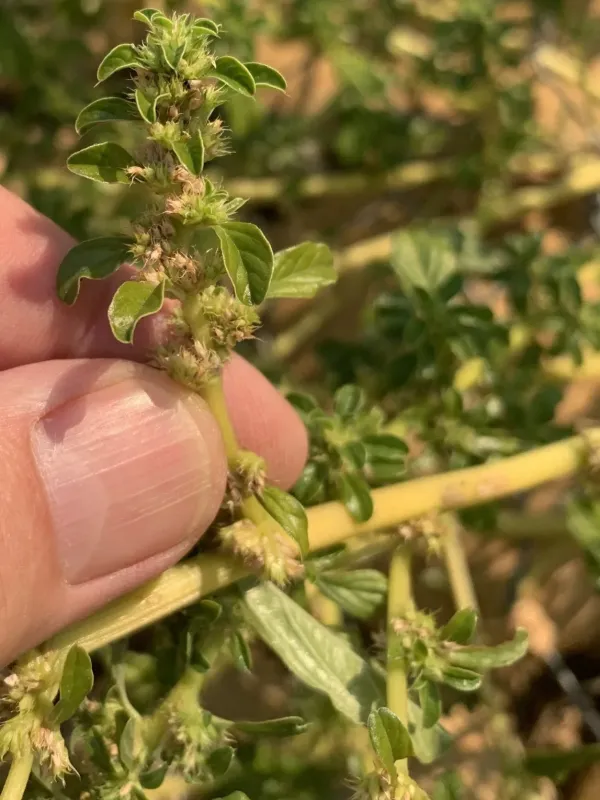
Tumbleweed (Amaranthus albus) is an annual herbaceous weed belonging to the Amaranthaceae family. It is easily identified by its highly branched, whitish stem that becomes woody and brittle as the plant matures.
The leaves are small, spatulate or obovate, and arranged on short petioles. Small, greenish flowers grow in dense axillary clusters, often protected by the plant's foliage, making them difficult to notice.
Its taproot system is deep and well-developed, enabling the plant to thrive in dry and nutrient-poor soils. The seeds are minuscule, lens-shaped, and jet-black with a high luster, allowing them to persist in the seed bank for many years.
The most distinctive feature is its tumbleweed habit; upon maturity, the plant detaches at the root base, allowing the wind to blow it across fields, effectively scattering seeds over long distances.
Germination typically occurs in late spring when the soil temperature rises. It is highly competitive in the early stages of crop development, establishing itself quickly in disturbed areas.
This weed is commonly found in open, sunny environments such as roadsides, railway embankments, and waste areas. It prefers well-drained, sandy, or loamy soils but shows remarkable adaptability to various soil conditions.
In agricultural settings, it is a significant nuisance in row crops, particularly corn, sunflowers, and sugar beets. It thrives in inter-row spaces where light penetration is high and competition from other plants is minimal.
Tumbleweed often colonizes field edges and pathways, where it serves as a primary source for the further infestation of the inner field areas. It is particularly problematic in regions with semi-arid climates.
The plant frequently invades orchards and vineyards if soil management practices are neglected. Its ability to tolerate salt-affected soils makes it a dominant species in specific regional environments.
Due to its mobile nature, even well-managed fields can be re-infested every year if neighboring non-cultivated areas are not controlled properly.
The primary agricultural threat is its massive seed production. A single mature plant can produce hundreds of thousands of seeds, which quickly overwhelm the soil seed bank and complicate long-term weed control.
Tumbleweed is a fierce competitor for vital resources including moisture, sunlight, and soil nutrients. In moisture-stressed environments, it can significantly stunt the growth of cultural crops, leading to substantial yield losses.
The plant can release allelopathic compounds that inhibit the germination and development of surrounding crops, effectively suppressing their growth even without direct physical competition.
It acts as an alternative host for various crop diseases and insect pests, such as aphids, mites, and nematodes. This makes it a vector for viruses that can cause severe damage to commercial harvests.
In harvested grains, the presence of tumbleweed seeds constitutes a serious impurity. This results in dockage at grain elevators and requires costly additional cleaning processes to reach commercial quality standards.
Effective management begins with mechanical control, including timely cultivation and harrowing, which destroys seedlings before they become established. Deep plowing helps bury seeds, preventing them from emerging in the next season.
Chemical control involving pre-emergence and post-emergence herbicides is standard practice. It is crucial to rotate herbicide modes of action to prevent the development of resistant weed populations.
Crop rotation serves as a strategic tool to disrupt the lifecycle of the weed, especially when combined with competitive cover crops that shade out potential seedlings.
Field sanitation is essential; monitoring and removing plants along field borders prevents the tumbleweed from rolling into the crops and dropping its seed load during the autumn period.

