
Stachytarpheta urticifolia
Stachytarpheta urticifolia
Description
How to tell it apart
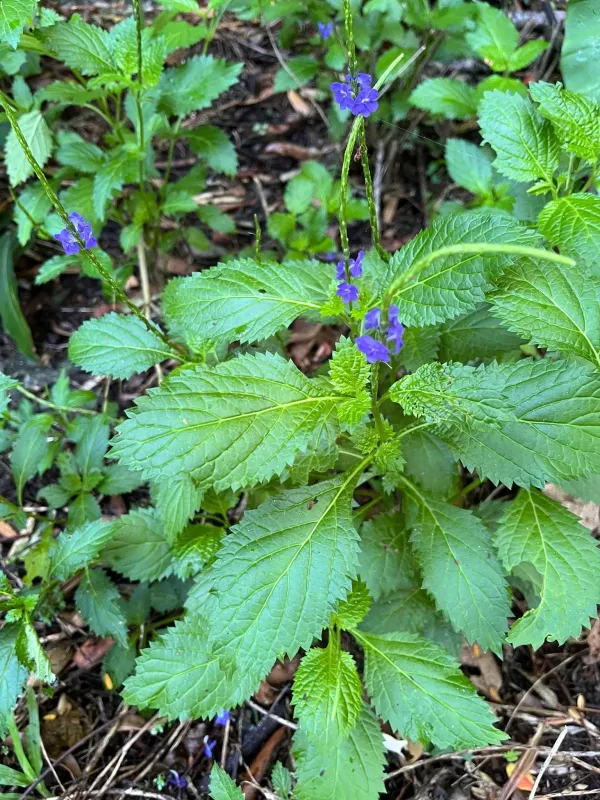
Stachytarpheta urticifolia, commonly known as the blue porterweed, belongs to the Verbenaceae family. It is a perennial herb or subshrub growing up to 1.5 meters tall.
The stems are erect, square in cross-section, and branch out significantly. The leaves are opposite, serrated, and have an ovate shape, resembling those of the stinging nettle.
The flowers are arranged in long, terminal spikes. Each flower is tubular, featuring a deep blue or purple corolla with five petals, which is a key diagnostic feature.
The fruits are small, dry schizocarps that split into two seeds. These seeds are easily dispersed by animals, wind, and movement of soil or water across landscapes.
The plant exhibits high adaptability and vigorous growth, allowing it to colonize diverse environments and survive under various stress conditions.
Where it grows
This weed is native to tropical regions and has become invasive in many parts of the world. It thrives in open, sunny areas with moderate moisture levels.
It is commonly found on roadsides, pastures, forest edges, and in disturbed agricultural lands where it rapidly dominates the local vegetation.
In farming systems, it is a significant nuisance in plantations such as cocoa, coffee, and coconut, where it competes for light and essential soil nutrients.
Stachytarpheta urticifolia often establishes itself in abandoned fields, forming dense thickets that prevent the succession of native plant species.
The plant is resilient and can grow throughout the year in warm climates, consistently occupying space that could be used for food production.
Harm it causes
The primary agricultural impact of this plant is nutrient and moisture competition. By extracting resources from the soil, it significantly reduces crop yields.
In grazing lands, it serves as an invasive competitor, displacing nutritious forage grasses and ultimately lowering the productivity of livestock operations.
The dense foliage of this species creates shade, which suppresses the development of desirable crop seedlings and limits their photosynthetic efficiency.
Mechanical operations are hindered by the presence of this weed, as it can clog equipment and increase the workload required for land maintenance.
Additionally, it acts as a secondary host for various insects and plant pathogens, increasing the overall phytosanitary risk to surrounding crops.
How to control
Cultural control methods involve frequent weeding and manual removal, which should be performed before the plant reaches its flowering stage to prevent seed set.
Utilizing ground-cover crops is a highly effective preventative strategy, as it shades the soil and inhibits the germination of new weed seeds.
Chemical control focuses on the use of systemic herbicides, which translocate through the plant to kill the root system, preventing regrowth.
- Application of non-selective systemic herbicides on fallow ground or non-crop areas.
- Targeted application of selective herbicides in plantation rows to minimize damage to permanent crops.
- Regular monitoring and spot-spraying of re-emerging individuals to ensure total eradication.
An integrated pest management approach, combining physical removal with chemical timing, ensures sustainable suppression of this weed in commercial agriculture.
Taxonomy
- Latin name
- Stachytarpheta urticifolia
- Family
- Вербена лекарственная
- EPPO code
- STCUR