
Phyla nodiflora
Phyla nodiflora
Description
How to tell it apart
Phyla nodiflora, commonly known as turkey tangle fogfruit, is a creeping perennial plant belonging to the Verbenaceae family. It spreads via stolons that root at the nodes, forming dense mats.
The leaves are opposite, spatulate or obovate, with serrated margins towards the apex. The foliage is often grayish-green due to fine pubescence on the leaf surface.
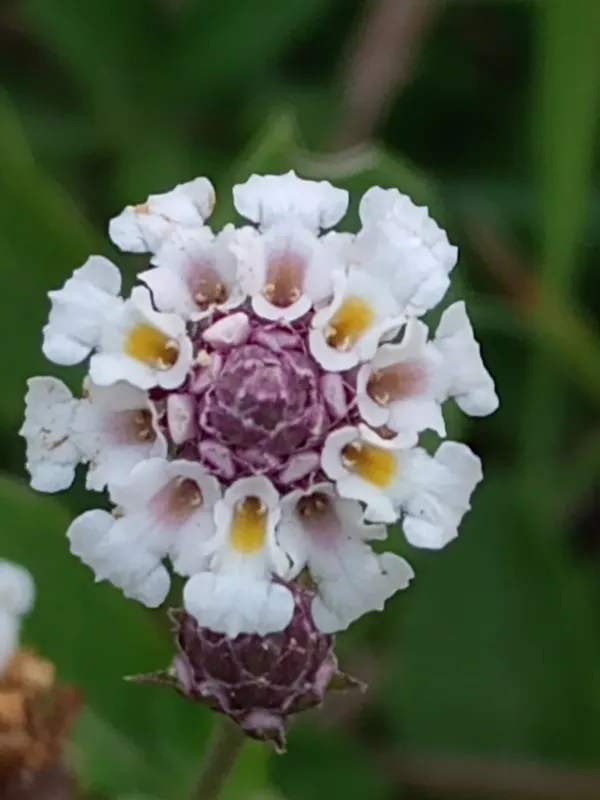
Flowers are arranged in small, dense, cone-shaped spikes borne on long peduncles. The blossoms range in color from white to pinkish-purple, often with a yellow throat.
The root system consists of persistent stems that crawl along the soil surface, allowing the plant to rapidly colonize bare soil and outcompete native or crop vegetation.
Small nutlets are produced in large quantities and are easily dispersed by water runoff, agricultural machinery, and even movement of contaminated nursery stock or soil.
Where it grows
Phyla nodiflora thrives in moist habitats, including stream banks, wetlands, and low-lying areas. It is frequently found in irrigation ditches and moist fields.
In agricultural settings, it is a significant weed in orchards, vineyards, and row crops that rely on irrigation, as it exploits the consistent moisture supply.
The weed is highly adaptable, growing well in various soil textures, but it shows a distinct preference for compacted, heavy clay soils that retain water well.
Native to tropical and subtropical regions, the plant has successfully invaded many temperate areas worldwide, often facilitated by human-mediated dispersal.
Field infestation usually begins at the edges of irrigation channels or low spots, later spreading throughout the cultivated area via vegetative propagation during tillage.
Harm it causes
The primary harm caused by Phyla nodiflora is the formation of thick ground cover, which prevents crop germination and shades out seedlings, severely limiting early growth.
As a vigorous competitor for water and mineral nutrients, it drastically reduces the overall vigor and yield potential of cash crops, especially in water-limited environments.
The plant creates physical interference for agricultural machinery, as its long, trailing stems frequently clog discs, cultivators, and harvesting equipment.
It acts as an alternative host for various plant viruses and insect pests, which can migrate to crops, increasing the pressure on integrated pest management programs.
In grazing lands, it displaces desirable forage species, leading to lower pasture productivity and forcing farmers to incur additional costs for re-seeding and maintenance.
How to control
Mechanical control focuses on deep tillage to break the stolon network and expose the roots to desiccation, which is most effective under hot and dry conditions.
Crop rotation incorporating highly competitive plants that provide rapid canopy closure is an essential cultural practice to starve the weed of necessary light.
In high-value orchard systems, the application of organic or synthetic mulches effectively suppresses Phyla nodiflora by blocking light and preventing stolon rooting.
Chemical control involves the use of systemic herbicides applied during periods of active growth, ensuring that the active ingredients translocate to the creeping roots.
- Glyphosate-based herbicides for spot treatment.
- Selective post-emergence herbicides for broadleaf control.
- Frequent mowing or mechanical removal in early stages of infestation.
Taxonomy
- Latin name
- Phyla nodiflora
- Family
- Вербена лекарственная
- EPPO code
- LIPNO