
Bouchea prismatica
Bouchea prismatica
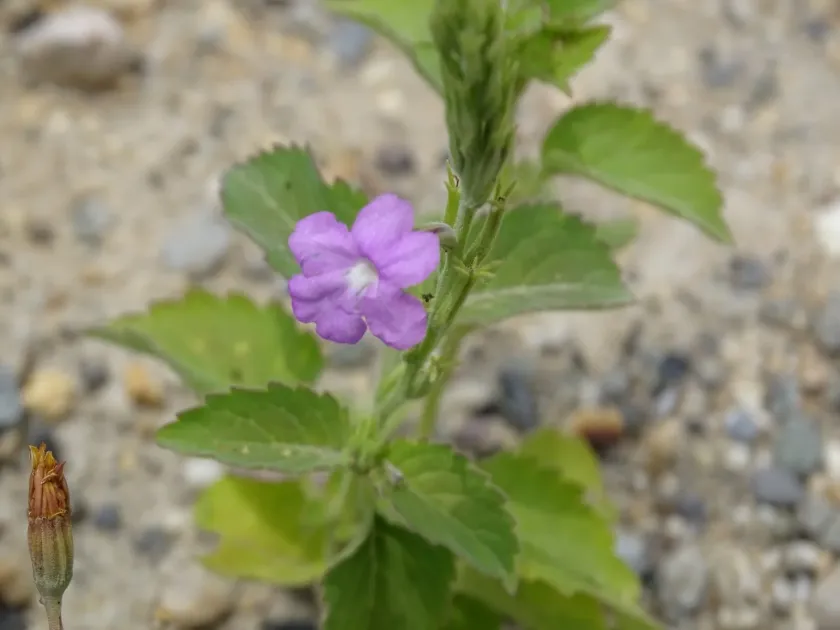
Description
How to tell it apart
Bouchea prismatica belongs to the Verbenaceae family. It is an herbaceous plant that can be either annual or perennial, characterized by its erect, branched stems that grow between 30 and 80 cm in height.
The leaves are arranged oppositely along the stem and have an oblong-ovate shape with serrated margins. The leaf surface often feels rough, which is a key identification feature for agronomists.
The most distinctive feature of the plant is its inflorescence, which forms long, spike-like racemes. As the fruits mature, the spike elongates significantly, holding the small seeds securely until dispersal.
The flowers are small with a tubular corolla, typically displaying vibrant shades of blue, purple, or violet. These flowers are highly efficient in attracting pollinators, ensuring successful reproduction.
The plant possesses a robust root system, which enables it to withstand periods of stress and quickly re-establish itself even after mechanical disturbance.
Where it grows
Bouchea prismatica is native to tropical and subtropical regions of the Americas. It is widely distributed across North and South America, as well as the Caribbean islands.
This weed thrives in disturbed environments such as roadsides, abandoned pastures, empty lots, and fields where the soil has been recently turned but left unplanted.
In agricultural settings, it is a significant competitor in row crops like soybeans, maize, and cotton. It favors open spaces where it can access high levels of sunlight.
Its ability to adapt to varying moisture conditions allows it to occupy both well-drained slopes and more moist field edges, making it a versatile and persistent invader.
The presence of this weed is often an indicator of poor field management or insufficient weed suppression during the early stages of crop development.
Harm it causes
The primary harm caused by Bouchea prismatica is its intense competition with crops for nutrients and water. In fields with heavy infestation, crop yields can be significantly reduced.
Due to its rapid vegetative growth, the weed shades out smaller crop seedlings, preventing them from accessing sufficient light for photosynthesis and normal development.
The plant acts as an alternative host for various crop pests and pathogens. This creates a cycle where pests move from the weeds to the crops, complicating integrated pest management efforts.
During the harvest, the presence of these weeds clogs combine machinery and increases the volume of impurities in the harvested grain, leading to higher post-harvest processing costs.
Seed bank accumulation is a major concern. A single plant can produce thousands of seeds, which can remain viable in the soil for several years, ensuring long-term field infestation.
How to control
Mechanical control is the first line of defense. Frequent cultivation of inter-row spaces during the early growth stages is highly effective at killing seedlings before they set seed.
Crop rotation is an essential agronomical strategy. Integrating crops that create dense canopies can naturally suppress the growth of Bouchea prismatica by depriving it of the necessary light.
Chemical control involving selective herbicides is often necessary in heavily infested fields. Pre-emergence and post-emergence treatments should be applied according to local guidelines for the specific crop.
Good sanitation practices are vital. This includes mowing field margins to prevent the spread of seeds and cleaning farm machinery thoroughly before moving between fields.
- Regular mechanical cultivation.
- Strategic crop rotation.
- Application of selective herbicides.
- Sanitation of equipment and field borders.
Taxonomy
- Latin name
- Bouchea prismatica
- Family
- Вербена лекарственная
- EPPO code
- BOVPR