
Star-leaf sedum
Sedum alsinifolium
Description
How to tell it apart
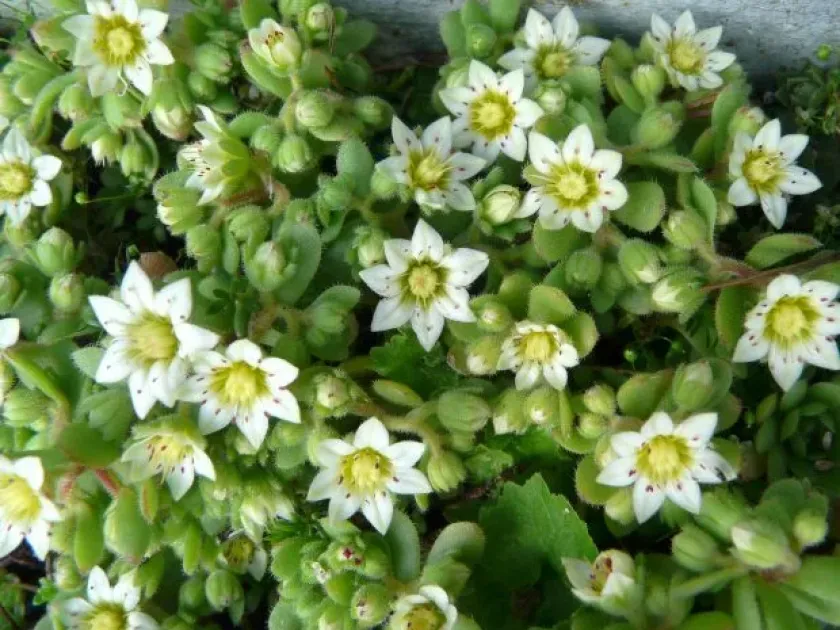
Star-leaf sedum (Sedum alsinifolium) is a member of the Crassulaceae family. It is a small, succulent plant characterized by its fleshy leaves and stems.
The plant typically grows in compact clusters, reaching heights of up to 15 centimeters, which makes it hardy and capable of surviving in difficult environments.
The leaves are alternate, ovate, and succulent, which helps the plant store moisture during periods of prolonged drought or heat stress.
Its small, pale-colored flowers are arranged in delicate inflorescences, typically appearing during the spring or early summer months.
Identification is primarily based on its fleshy, succulent nature and the shape of its star-like leaves, which distinguish it from common non-succulent weeds.
Where it grows
This weed prefers sunny, open environments with dry or rocky soils where competition from other fast-growing plant species is relatively low.
It is commonly found on disturbed sites, roadsides, waste lands, and in agricultural fields located in arid or semi-arid climatic zones.
In farming areas, it often encroaches upon fallow fields and edges of pastures, where it exploits neglected soil conditions to establish its population.
The plant is highly adaptable and can colonize areas with poor soil quality, making it a persistent weed in marginal agricultural land.
Its ability to propagate through vegetative parts and seeds allows it to spread efficiently across large areas if left unmanaged.
Harm it causes
The main impact of Star-leaf sedum on agriculture is its ability to outcompete crops for soil moisture, which is vital in dry farming conditions.
Because it is a succulent, it remains robust while other crops wilt, effectively stealing water and nutrient resources that are intended for the yield.
In hay and forage production, the presence of these fleshy plants can significantly increase drying times, leading to issues with mold and spoilage.
The dense growth of this plant can interfere with field management activities and reduce the overall efficiency of planting and harvesting operations.
Furthermore, it may act as a host for various agricultural pests, creating a reservoir for infestation that can spill over into primary crops.
How to control
Effective management requires a combination of cultural practices, such as crop rotation, to disrupt the life cycle and habitat of the weed.
Deep plowing and regular mechanical cultivation are essential to uproot the plants and expose their sensitive root systems to the sun, causing dehydration.
For large infestations, selective chemical herbicides with systemic action are recommended to ensure complete destruction of the succulent foliage.
Manual removal or regular mowing of field borders and marginal areas is effective in preventing the spread of seeds into the main production field.
Applying adjuvants in herbicide mixes is crucial to facilitate the absorption of the active ingredient through the thick cuticle of the succulent leaves.
Taxonomy
- Latin name
- Sedum alsinifolium
- Family
- Толстянковые
- EPPO code
- SEDAF