
Crassula saginoides
Crassula saginoides
Description
How to tell it apart
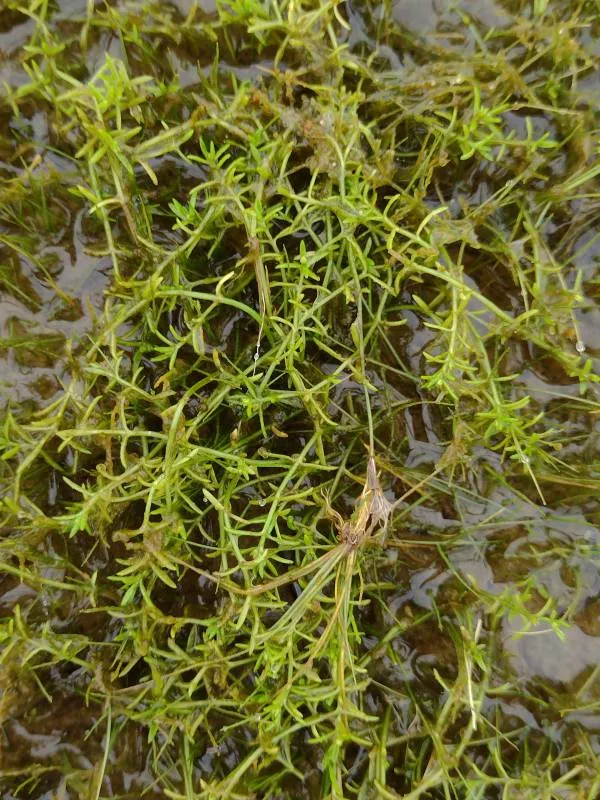
Crassula saginoides is a small herbaceous plant belonging to the Crassulaceae family. It is named for its similarity to pearlwort (Sagina), featuring small succulent leaves arranged in opposite pairs along the stems.
The plant exhibits a prostrate growth habit, often forming dense mats or patches on the soil surface. It possesses a relatively weak, fibrous root system that allows it to easily establish itself in the top layer of moist soil.
Its small flowers are typically located in the leaf axils, displaying white or pale pink hues. Reproduction occurs through seeds and vegetative propagation, where even small stem fragments can take root if they come into contact with moist soil.
The life cycle of this weed enables it to quickly occupy vacant niches, particularly in areas with high soil moisture. It is generally considered a short-lived plant that completes its life cycle when moisture is abundant.
For accurate identification, one should observe the succulent nature of the stems and leaves, which is a distinctive feature even in very young specimens of this weed.
Where it grows
This species prefers open, moist, and disturbed habitats. It is most frequently found in low-lying fields where rainwater or irrigation runoff tends to pool after precipitation.
Crassula saginoides actively colonizes areas with light, sandy, or loamy soils, where competition from more vigorous grass weeds might be temporarily limited.
In agroecosystems, it is often observed in cereal crop fields, particularly where drainage systems are inadequate. It can also act as a weed in vegetable rotations under intensive irrigation regimes.
The plant is capable of withstanding temporary flooding, giving it a competitive advantage over many crop plants that are sensitive to excess water in the root zone.
Outside agricultural fields, it is commonly found along ditches, irrigation canal banks, and field edges, where seeds are easily dispersed by farming machinery.
Harm it causes
The harm caused by Crassula saginoides lies primarily in its ability to compete with crop plants during the early stages of development when soil moisture is at its peak.
When present in large numbers, it forms a dense cover that inhibits proper soil aeration and warming of the topsoil, which negatively impacts the growth of the primary crop.
The weed can serve as a reservoir for certain soil-borne pests that thrive in moist conditions, which may eventually migrate to crop fields and cause direct damage.
The presence of this weed interferes with field operations, especially mechanical cultivation, as the biomass can clog the working components of agricultural machinery.
Under irrigation conditions, Crassula significantly reduces water-use efficiency by consuming water during periods that are critical for the development of the primary crop.
How to control
The primary control measure is the improvement of field drainage systems to eliminate excess soil moisture, which is the key factor enabling the spread of this species.
Agrotechnical practices include deep autumn plowing, which buries seeds at depths that inhibit germination and disrupts the vegetative parts of the plant.
- Regular mechanical cultivation to disturb the soil surface.
- Crop rotation featuring competitive plants to shade out the weed.
- Leveling the field surface to prevent the formation of stagnant water pools.
Chemical control is generally achieved through the application of broad-spectrum herbicides during the early developmental stages when the weed is most susceptible.
The selection of a specific herbicide must be based on the crop type and growth stage to avoid phytotoxicity, especially when applying treatments in highly moist conditions.
Taxonomy
- Latin name
- Crassula saginoides
- Family
- Толстянковые
- EPPO code
- CSBSA