
Crassula pubescens
Crassula pubescens
Description
How to tell it apart
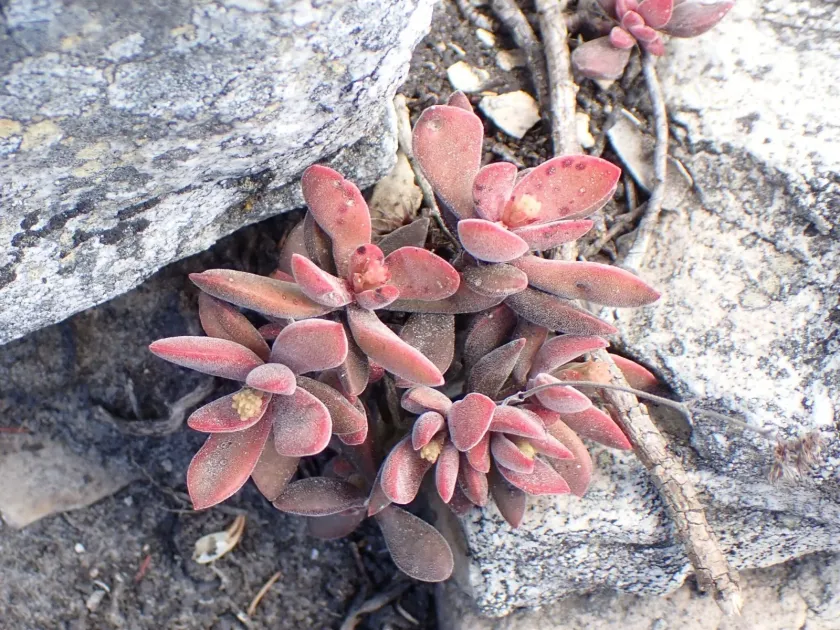
Crassula pubescens is a perennial succulent plant belonging to the Crassulaceae family. It is recognized by its fleshy leaves and stems that are covered in fine, dense hairs, which help the plant adapt to dry environments.
The leaves are typically opposite, oval or elliptical in shape, and often develop a reddish hue when exposed to intense direct sunlight, which is a common survival strategy in its native habitat.
The root system is fibrous and shallow, yet highly efficient at absorbing moisture. The plant spreads both by seeds and vegetatively; even small stem segments can take root if they come into contact with moist soil.
Small white or pale pink flowers bloom in clusters at the tips of the stems, followed by the production of numerous tiny seeds that are easily dispersed by wind across large agricultural areas.
As a succulent, it possesses a unique metabolism that allows it to store water, providing a distinct competitive advantage in arid regions where other weeds might perish from drought.
Where it grows
Crassula pubescens is predominantly found in arid and semi-arid regions, thriving in sandy or rocky soils where competition for water is high among native vegetation.
In agricultural settings, it frequently invades vineyards, orchards, and row crops, particularly in areas where infrequent soil cultivation allows it to establish dense colonies.
The plant often colonizes disturbed areas such as roadsides, field margins, and waste ground, creating a seed bank that constantly re-infests nearby cultivated farmland.
It prefers well-drained soils and can withstand high temperatures, making it a persistent nuisance in Mediterranean-type climates or regions with dry, long summers.
On grazing lands, it can be problematic as it tolerates low-nutrient soils and spreads rapidly, eventually crowding out more desirable forage grasses and legumes.
Harm it causes
The primary damage caused by Crassula pubescens is its direct competition with crops for essential soil moisture, nitrogen, and phosphorus, leading to reduced overall agricultural output.
By effectively sequestering moisture in its tissues, the plant survives conditions that induce drought stress in crops, effectively "stealing" the resources necessary for crop maturation.
Dense infestations create significant mechanical obstacles, interfering with irrigation systems, weeding equipment, and harvesting machinery, thus increasing the cost of production.
The presence of these succulents can degrade soil quality, as they create a persistent mat that prevents the germination of desirable seeds and can harbor specific plant pathogens.
Furthermore, in fodder crops, the presence of these weeds can diminish the feed value, as certain Crassula species may contain compounds that are unpalatable or potentially toxic to livestock.
How to control
Controlling Crassula pubescens requires a combination of mechanical and chemical strategies, as its succulent nature makes it resistant to simple physical removal if fragments remain in the soil.
Deep plowing and regular mechanical cultivation are essential to uproot the plants and expose them to drying conditions, which is crucial for killing the resilient stem segments.
Preventive measures include maintaining clean field margins and ensuring that all agricultural machinery is thoroughly cleaned before moving between fields to avoid spreading fragments.
Chemical control with herbicides is effective but requires the addition of specialized surfactants or adjuvants, as the plant's hairy, waxy surface can repel conventional water-based sprays.
Integrated weed management should also focus on crop rotation, encouraging strong canopy growth in cultivated plants to shade out and limit the growth of this light-loving succulent.
Taxonomy
- Latin name
- Crassula pubescens
- Family
- Толстянковые
- EPPO code
- CSBPU