
Crassula connata
Crassula connata
Description
How to tell it apart
Crassula connata, commonly known as sand pygmyweed, is a small, herbaceous plant belonging to the Crassulaceae family. It is recognized by its tiny size, usually growing only a few centimeters tall.
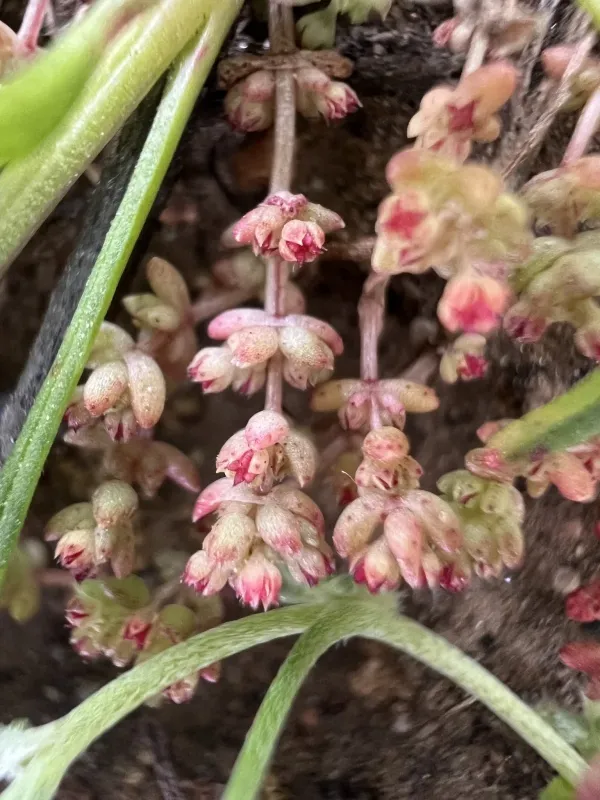
The stems are branched at the base and often exhibit a reddish coloration. The leaves are opposite, connate at the base—a diagnostic feature that gives the species its name—and are typically succulent and ovate-lanceolate in shape.
The flowers are extremely small, white or greenish-pink, and lack conspicuous pedicels. They are located in the leaf axils, making them easily overlooked in the field environment.
Its root system is fibrous and relatively shallow, allowing it to colonize disturbed surfaces rapidly. The plant propagates entirely through seed production, which occurs in high volumes per plant.
This species is considered an ephemeral, completing its entire life cycle from germination to senescence during brief, favorable moisture windows, which is a key survival strategy.
Where it grows
Sand pygmyweed favors open, well-lit environments with light, sandy, or loamy soil textures. It is frequently found on hillsides, in desert regions, and near vernal pools or seasonal water sources.
In an agricultural context, it poses a challenge for early-season cereal crops and various row crops. It tends to colonize areas with sparse crop coverage or exposed soil surfaces.
The geographic range is primarily concentrated in the western regions of North America, though its adaptability allows it to persist in various climates with Mediterranean-like moisture regimes.
It often becomes a nuisance weed in nurseries, greenhouses, and irrigated fields where consistent moisture levels provide ideal conditions for its rapid development.
Despite its small stature, the high density of its populations allows it to cover large areas, forming dense mats that suppress the establishment of desirable vegetation.
Harm it causes
The primary agricultural impact of Crassula connata is its competitive nature regarding soil moisture and essential nutrients during the early stages of crop development, where it acts as a significant resource drain.
Massive outbreaks in fields can severely inhibit the growth of young crop seedlings. Because it completes its cycle quickly, it hits the crop during the most vulnerable period of establishment.
The dense mats formed by this weed can create localized increases in humidity around the crop base, which potentially promotes the development of various soil-borne pathogens and fungal rot diseases.
Managing this weed is complicated by its size, as it often goes unnoticed until the population is large enough to impact yield. This makes early detection in field scouting very difficult.
In high-intensity farming, the presence of Crassula connata leads to yield reductions by occupying space and consuming nitrogen and water that should be utilized by the primary crop.
How to control
Thorough pre-plant tillage is the most effective cultural method for control. Cultivation or harrowing effectively destroys emerging seedlings before the main crop is even planted.
Crop rotation is essential; using competitive crops that establish a dense canopy helps suppress the light-demanding pygmyweed by limiting its access to photosynthetic resources.
Chemical control involves the application of selective herbicides during the early stages of the weed's growth. Several broadleaf-targeting herbicides have shown efficacy in controlling this species.
Prevention of seed rain is critical for long-term population management. Eliminating the weeds through mowing or chemical intervention before they reach the flowering stage is highly recommended.
- Clean all agricultural machinery thoroughly to prevent seed spread.
- Maintain optimal crop density to shade out the soil.
- Monitor fields closely after heavy rain events during early growth stages.
Taxonomy
- Latin name
- Crassula connata
- Family
- Толстянковые
- EPPO code
- CSBCN