
New Zealand pigmyweed
Crassula helmsii
Description
How to tell it apart
Crassula helmsii is a perennial succulent aquatic or semi-aquatic plant belonging to the Crassulaceae family. Its appearance varies significantly depending on the habitat; it can grow either fully submerged or on damp, marshy banks.
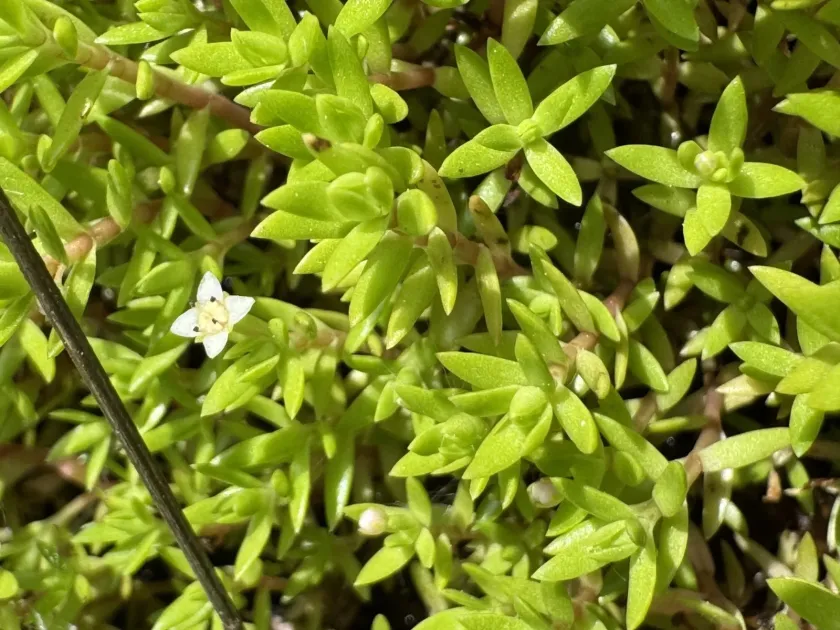
The stems are branched and root at the nodes, covered densely with opposite, linear leaves. The leaves measure between 5 and 20 mm, exhibiting the bright green, fleshy structure characteristic of the Crassula genus.
The flowers are tiny, solitary, and situated in the leaf axils on short stalks. They typically consist of four white or pinkish petals that bloom between July and September, although flowering is rare in northern latitudes.
The root system is highly developed and possesses remarkable regenerative capabilities. Even the smallest fragment of the stem, provided it contains a node, can sprout into a new, fully functional plant, making it extremely resilient in various substrates.
This plant is capable of tolerating a wide range of temperatures, remaining green even under ice, which allows it to successfully colonize new territories in temperate climates and outcompete native aquatic flora.
Where it grows
The primary habitat of Crassula helmsii includes stagnant or slow-moving water bodies such as ponds, lakes, irrigation canals, and flooded quarries. It prefers silt or sandy sediment rich in nutrients.
In recent decades, this weed has been actively spreading across Europe, posing a serious threat to aquatic ecosystems. In agricultural settings, it is frequently found in irrigation systems, disrupting flow and hindering proper water usage.
The plant thrives at depths of up to 1.5 meters as well as on waterlogged banks, where it forms dense, carpet-like mats. Its high phenotypic plasticity allows it to colonize even temporarily drying canal sections.
The spread to new locations is mainly anthropogenic, occurring via fishing equipment, boats, machinery used for water management, and unauthorized introduction by pond owners.
Crassula helmsii is considered an invasive species because it lacks natural enemies in its non-native regions, allowing it to form monocultures that suppress the development of all other aquatic vegetation.
Harm it causes
The damage caused by this weed lies in its ability to form ultra-dense mats that block sunlight from reaching the water column, which is lethal to phytoplankton and other submerged aquatic plants.
The decay of accumulated organic matter from dead Crassula mats leads to a sharp decline in dissolved oxygen, causing mass mortality of fish and aquatic invertebrates, thereby disrupting the ecological balance of the water body.
In agriculture, the primary harm is associated with the blockage of irrigation canals. These dense mats create bottlenecks, reduce water flow velocity, and significantly increase the risk of flooding in adjacent farmland.
The plant limits access to water for livestock and makes aquaculture or fisheries management extremely difficult. Economic losses are driven by the necessity for constant mechanical dredging and cleaning.
Furthermore, the presence of this weed prevents mechanized maintenance or harvesting along the shoreline, as equipment frequently becomes bogged down in the thick, interwoven root mass of the pigmyweed.
How to control
Agrotechnical control measures focus on strict hygiene protocols, such as cleaning all equipment, tools, and boats after contact with infested waters to prevent the transfer of plant fragments to unaffected sites.
Mechanical removal is the most common approach, but it must be performed with extreme caution. Specialized nets or excavators must be used in conjunction with mandatory collection of all debris to prevent regrowth from fragments.
In certain scenarios, shading techniques are employed: covering the water surface with opaque materials for an extended period (several months) can starve the plant of light, leading to exhaustion and death.
Chemical control is complicated by the high toxicity of most herbicides to aquatic life. The use of approved glyphosate-based formulations is permitted only on dry land or canal banks, adhering strictly to dosage regulations.
A multi-disciplinary approach is most effective, combining the mechanical removal of large infestations with persistent long-term monitoring and targeted, localized herbicide applications during the plant's active growing season.
Taxonomy
- Latin name
- Crassula helmsii
- Family
- Толстянковые
- EPPO code
- CSBHE