
Water pygmyweed
Crassula aquatica
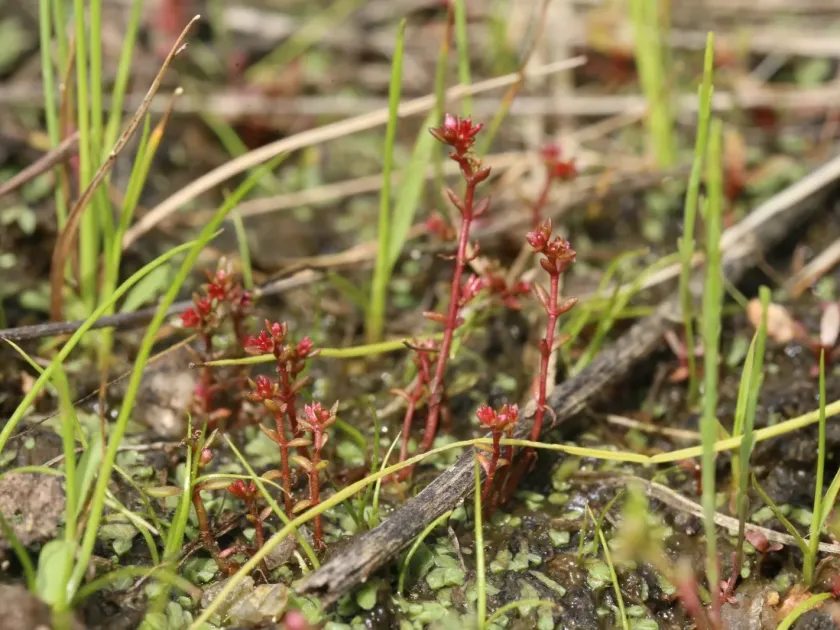
Description
How to tell it apart
Water pygmyweed belongs to the Crassulaceae family. It is a small annual herbaceous plant that often exhibits succulent-like features, well-adapted to aquatic environments.
The stems are typically branched, either decumbent or ascending, reaching heights of 2 to 10 centimeters. The leaves are opposite, sessile, and range in shape from oblong to linear.
Flowers are very small and solitary, located in the leaf axils. They consist of four petals that are whitish or pinkish, making them relatively inconspicuous in the field.
The root system is shallow, which allows the plant to easily establish itself in muddy soils or saturated substrates near irrigation ditches.
It reproduces via seeds that are produced in capsules, contributing to its ability to colonize damp patches in agricultural fields rapidly.
Where it grows
This plant prefers environments with high moisture content. It is commonly found on the damp shores of ponds, muddy riverbanks, and in drainage ditches.
In agricultural settings, water pygmyweed is a nuisance in irrigated lands, particularly in rice paddies and fields where poor drainage results in persistent waterlogging.
It competes aggressively with crops in its early growth stages, taking advantage of the wet soil conditions that are often maintained for the main crop.
Dispersal primarily occurs through irrigation water and the movement of contaminated farm machinery between different fields.
The presence of this weed serves as a biological indicator of poor drainage or imbalanced water management within the field irrigation system.
Harm it causes
The primary damage caused by water pygmyweed is its intense competition for water and soil nutrients with high-value crops like rice or vegetables during germination.
Dense mats of the plant can block soil warming, which is essential for the healthy development of many heat-loving crops early in the season.
The weed interferes with standard mechanical practices, such as inter-row cultivation, and complicates the uniform distribution of fertilizers.
It can create a microclimate that harbors pests or promotes the growth of pathogens due to the retained moisture in the crop canopy and soil surface.
Infestation leads to reduced crop yields due to direct suppression of seedlings and the alteration of the soil environment surrounding the crop roots.
How to control
The most effective long-term strategy is improving field drainage and leveling to prevent standing water, which directly removes the weed's habitat requirements.
Standard agronomic practices, such as deep plowing and timely inter-row cultivation, are essential for destroying seedlings before they can establish.
Crop rotation that includes non-irrigated phases or crops that form a dense canopy can effectively shade out and suppress water pygmyweed populations.
Chemical control may be necessary in intensive systems, provided the chosen herbicides are compatible with the primary crop's growth stage.
- Regular maintenance of irrigation and drainage infrastructure.
- Ensuring seed purity to prevent the introduction of weeds to new fields.
- Precise management of water levels to avoid field saturation.
Taxonomy
- Latin name
- Crassula aquatica
- Family
- Толстянковые
- EPPO code
- CSBAQ