
Decumbent crassula
Crassula decumbens
Description
How to tell it apart
Decumbent crassula (Crassula decumbens) is a small annual succulent weed belonging to the Crassulaceae family, often found in damp agricultural environments.
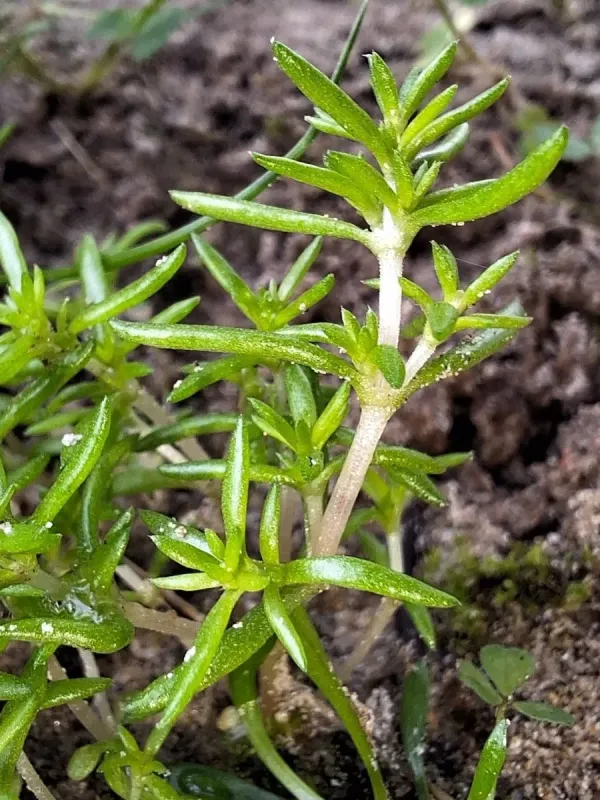
The plant features succulent, fleshy leaves that are typically arranged in opposite pairs, often displaying a reddish or bronze tinge under intense light.
Its stems are prostrate or ascending, often rooting at the nodes when in contact with moist soil, which makes the plant highly resilient to mechanical disturbance.
The flowers are small, white to pinkish, and arranged in axillary inflorescences that produce large amounts of tiny, easily dispersed seeds.
Biological classification places it among short-lived ephemeral species that prioritize rapid vegetative growth and seed set in favorable conditions.
Where it grows
This weed prefers moist, open, and well-lit areas, frequently occurring in sandy or well-drained loamy soils across various agricultural fields.
It is commonly encountered in vegetable crop production, nursery settings, and damp patches within grain fields where irrigation creates persistent moisture.
Decumbent crassula spreads efficiently along drainage ditches and irrigation channels, utilizing water movement for seed dispersal across entire farming areas.
It thrives in disturbed soil, quickly colonizing fallow lands or areas where the primary crop has not yet formed a closed canopy.
The species demonstrates high adaptability, persisting in diverse climate zones provided that soil moisture remains sufficient for germination.
Harm it causes
The primary damage caused by decumbent crassula is the direct competition with young crop seedlings for sunlight, moisture, and soil nutrients.
By forming dense, low-growing mats, the weed suppresses the growth of smaller crop plants and limits their access to necessary resources.
The dense foliage creates an ideal microclimate for the development of fungal pathogens and root rots, jeopardizing the health of the primary crop.
Massive infestations lead to significant yield reductions, especially in high-value vegetable crops where uniform growth is essential.
Due to its high reproductive capacity, the weed rapidly saturates the soil seed bank, creating long-term management challenges for producers.
How to control
Mechanical control is effective in the early stages; frequent inter-row cultivation helps destroy the root systems and prevents stem rooting.
Crop rotation should be utilized to manage moisture levels and competition, favoring crops that provide early canopy closure to shade out the weed.
Chemical control includes the application of post-emergence herbicides, though the succulent nature of the leaves may require surfactants to improve efficacy.
Glyphosate-based treatments are recommended for fallow fields or prior to planting to ensure the total eradication of the weed and its seed sources.
Proper maintenance of irrigation infrastructure is crucial to prevent the spread of seeds through water channels and into the main field areas.
Taxonomy
- Latin name
- Crassula decumbens
- Family
- Толстянковые
- EPPO code
- CSBDE