
Fiddle-leaf phacelia
Phacelia viscida
Description
How to tell it apart
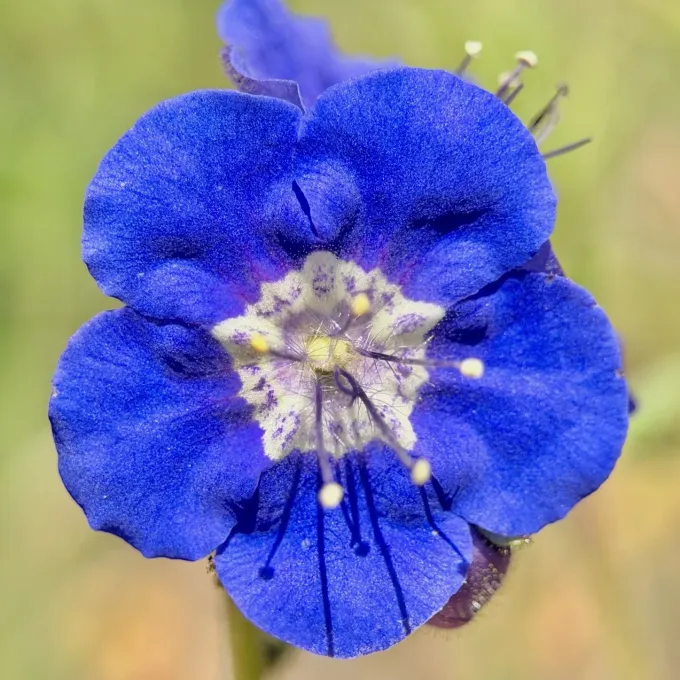
Phacelia viscida, commonly known as fiddle-leaf phacelia or sticky phacelia, is an annual herbaceous plant belonging to the Boraginaceae family. It is easily distinguished by the presence of dense glandular hairs that secrete a sticky, resinous substance.
The plant grows to a height of 20 to 50 centimeters with erect, branching stems. Its leaves are alternate and deeply pinnately lobed, which gives the plant a distinct, fern-like appearance that is often covered in viscous secretions.
The flowers are bell-shaped and typically display a striking blue or violet color with a white or pale center. These blooms are visually appealing but are produced by a plant that acts as an aggressive weed in disturbed soil environments.
A key identification feature is the texture of the stems and leaves. When touched, the plant feels highly tacky or sticky, a property that helps it trap small insects and makes it difficult to handle during manual weeding operations.
The root system is fibrous and taproot-based, allowing the plant to quickly establish itself in loose or cultivated soil. Once established, it develops rapidly, outcompeting local flora and forming dense patches that are difficult to manage.
Where it grows
Native to California, Phacelia viscida is found in various open, sunny habitats including coastal scrub, chaparral, and hillsides. In an agricultural context, it thrives in disturbed fields, fallow land, and edges of cultivated plots.
The plant prefers well-drained soils and high-light conditions. It often invades agricultural lands when soil structure has been disrupted, taking advantage of the lack of competition from other more desirable plant species.
Phacelia viscida can spread into fields through contaminated seed supplies or by hitchhiking on farm machinery. Because its seeds are small and easily dispersed, it can rapidly colonize large areas if left unchecked during the early stages of growth.
It is frequently observed along road verges and field margins, serving as a primary source of seeds for neighboring crops. The ability of the plant to adapt to various moisture levels makes it a resilient weed in diverse climatic conditions.
If the field is not managed correctly, this species can form a significant portion of the weed biomass. It thrives in sparse crop stands where there is ample room for individual plants to expand and mature.
Harm it causes
The primary harm caused by Phacelia viscida in agriculture is the competition for nutrients and water. By occupying the available space, it significantly reduces the growth and vigor of essential crops, leading to lower yield potentials.
Its sticky nature poses a significant mechanical challenge. The resinous secretion can accumulate on harvesting equipment, such as combines or mowers, leading to machinery clogging and maintenance issues that delay harvesting processes.
The weed shades out young crop seedlings, particularly in low-density plantings. This shading effect deprives the crops of essential sunlight, hindering the early developmental stages and slowing down overall biomass accumulation.
Phacelia viscida may also act as an alternate host for various plant pathogens or insect pests that migrate into neighboring crops. This necessitates increased pesticide use and complicates the overall integrated pest management strategy of the farm.
Furthermore, the presence of these weeds decreases the overall quality of the harvest. Contamination of grain or seed lots with phacelia fragments or seeds can lower market value and increase post-harvest processing costs.
How to control
Effective management begins with strict seed quality control. Using certified, weed-free seeds is the most efficient way to prevent the introduction of Phacelia viscida onto agricultural land.
Mechanical cultivation remains an effective strategy. Shallow tillage or inter-row cultivation during the early growth phase of the weed can easily destroy young seedlings before they produce a mature root system or seeds.
Crop rotation serves as a powerful deterrent. By alternating crops, farmers can disrupt the growth cycle of Phacelia viscida and prevent it from becoming the dominant vegetation in the field over consecutive seasons.
Chemical control with systemic herbicides is effective during the pre-planting phase. Targeted application of appropriate herbicides on fallow ground can eliminate the weed before the main crop is sown, reducing the need for post-emergence chemical interventions.
- Regular monitoring of field margins.
- Sanitizing machinery between field transfers.
- Deep plowing to bury weed seeds.
- Utilizing competitive cover crops to suppress germination.
Taxonomy
- Latin name
- Phacelia viscida
- Family
- Бурачниковые
- EPPO code
- PHCVI