
Corn gromwell
Buglossoides arvensis
Description
How to tell it apart
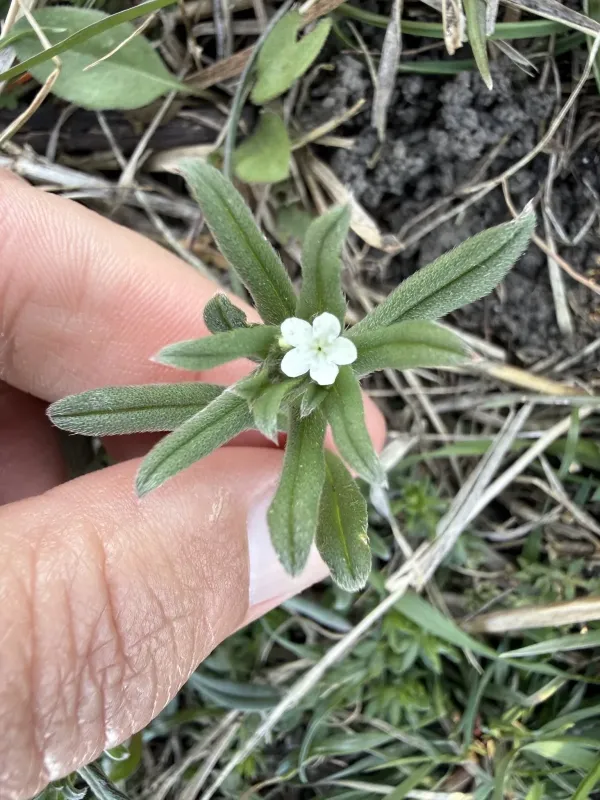
Buglossoides arvensis, commonly known as corn gromwell, is an annual herb belonging to the Boraginaceae family. It typically features an erect, often branched stem that reaches heights between 15 and 50 cm.
The leaves are lanceolate or linear-lanceolate, covered with stiff, appressed hairs, giving the plant a grayish-green appearance. The root system is a taproot that penetrates the soil to a shallow depth.
Its flowers are small and white, sometimes with a bluish tinge, arranged in leafy terminal coils. The fruit consists of nutlets with a warty surface, which facilitates their dispersal by animals or wind.
Flowering occurs from April to July, with a long maturation period that ensures high seed production. The plant propagates exclusively through seeds, which can remain viable in the soil for several years.
Seedlings emerge in autumn or early spring. This allows the plant to overwinter in a rosette stage, giving it a significant competitive advantage over spring-sown crops.
Where it grows
This weed is widespread in temperate climates. It prefers well-drained, lime-rich soils and is commonly found on clay and loamy substrates in agricultural fields.
Corn gromwell thrives in open, sunny environments, including cereal crop fields, fallow lands, and roadsides. It is particularly competitive in fields with thin or sparse crop stands.
In recent years, the plant has become a frequent weed in reduced-tillage farming systems, as seeds remain near the soil surface, favoring early germination.
Its geographical range encompasses almost all of Europe, Central Asia, and parts of North America, where it has successfully adapted to diverse agricultural practices.
The plant is highly resilient and can colonize abandoned fields and poorly managed plots, serving as a primary source for re-infestation of nearby cultivated areas.
Harm it causes
The main damage is caused by intense competition with crops for nutrients and water, especially during the critical stages of early spring development when winter crops resume growth.
Heavy weed infestations can lead to significant yield losses in cereal crops. Studies suggest that under severe conditions, yield reductions can range from 10% to 20%.
Buglossoides arvensis can host various pests and pathogens that may spread to the main crop, thereby increasing the overall disease pressure in the field.
The presence of weed seeds in the harvested grain lowers its commercial quality and increases the costs associated with post-harvest cleaning and processing.
Furthermore, early-season infestation stunts the tillering of wheat and barley, preventing the formation of healthy, productive heads and reducing the total harvest potential.
How to control
Effective management begins with thorough pre-sowing cultivation, which helps eliminate early weed seedlings before the crop is sown or emerges.
Crop rotation is a vital strategy, particularly alternating between winter and spring cereals or incorporating row crops to disrupt the life cycle of the weed.
Chemical control usually involves the use of sulfonylurea herbicides or synthetic auxins. Application is most effective when the weed is in the rosette stage before it bolts.
Ensuring the use of certified, clean seed is critical, as contaminated grain is the primary method of introducing the weed into new areas.
- Deep plowing to bury weed seeds.
- Application of selective systemic herbicides.
- Mechanical weeding (harrowing) during the tillering stage.
- Management of field edges to reduce seed dispersal.
Taxonomy
- Latin name
- Buglossoides arvensis
- Family
- Бурачниковые
- EPPO code
- LITAR