
Amsinckia calycina
Amsinckia calycina
Description
How to tell it apart
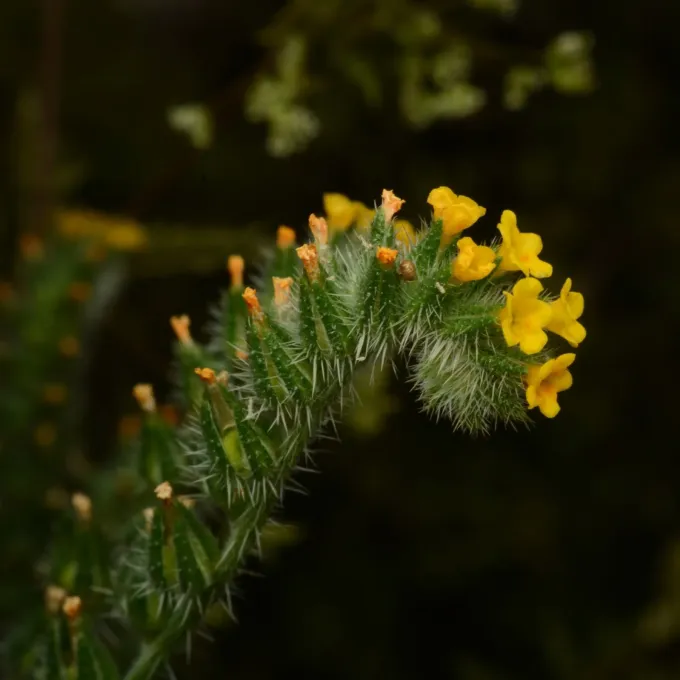
Amsinckia calycina, often referred to as a type of fiddleneck, is an annual herbaceous plant belonging to the Boraginaceae family. It is characterized by stiff, prickly hairs covering its stems and leaves, which can cause significant skin irritation upon contact.
The leaves are lanceolate or linear-lanceolate in shape, arranged alternately along the stem. The plant produces distinctive coiled inflorescences that resemble the shape of a fiddle neck, which is a key diagnostic feature of this genus.
The flowers are small, tubular, and bright yellow to orange-yellow in color. As the plant matures, it develops small, nutlet-like seeds that are covered with bumps and ridges, aiding in their dispersal via animals and machinery.
The seedlings typically emerge during the autumn or early spring, allowing the plant to establish itself ahead of many spring-sown crops. This early development gives it a competitive advantage in the field.
Overall, the plant has a rugged, hairy appearance that remains consistent throughout its lifecycle, making it relatively easy to distinguish from smoother broadleaf weeds in a field setting.
Where it grows
This weed thrives in open, sun-drenched areas and is commonly found in disturbed soils, roadsides, fencelines, and fallow fields. From these sites, it easily invades neighboring agricultural land.
Amsinckia calycina is a significant threat to winter and spring cereal crops. It shows high adaptability to various soil types, ranging from sandy loams to heavier clays, provided there is adequate drainage.
The plant is particularly successful in arid and semi-arid regions where its deep root system allows it to compete effectively for limited soil moisture against crop plants.
High seed production enables the plant to form dense, persistent infestations. In fields where crop rotation is infrequent or soil tillage is minimal, the seed bank can build up rapidly over just a few seasons.
It is frequently observed in pastures and cereal fields, where it can dominate the landscape if not managed proactively through regular site monitoring and early intervention.
Harm it causes
The primary economic impact of Amsinckia calycina is the reduction in crop yield caused by competition for water, nutrients, and solar radiation. Its rapid growth phase often coincides with the critical development stages of cereal crops.
The plant is known to contain pyrrolizidine alkaloids, which are toxic to livestock. Grazing animals or consumption of hay contaminated with the weed can lead to serious health issues, including liver damage in cattle and horses.
Harvested grain contaminated with fiddleneck seeds requires intensive cleaning processes, which increases post-harvest costs and may lead to dockage at the point of sale due to impurities.
The prickly, hairy texture of the plant makes it physically unpleasant to handle. In heavy infestations, the accumulation of plant material in combine harvesters can cause mechanical delays and increase maintenance requirements.
Furthermore, the plant's ability to crowd out crop seedlings in the early growth stages leads to uneven crop stands, ultimately compromising the overall uniformity and quality of the harvest.
How to control
Effective management begins with integrated crop rotation, alternating competitive crops with others that allow for different types of herbicide application or mechanical cultivation methods.
Mechanical control, including deep plowing and timely harrowing, is highly effective for destroying young seedlings before they produce viable seeds, thus preventing the replenishment of the soil seed bank.
Chemical control focuses on the use of selective herbicides. For cereal crops, post-emergence application is typically most effective when the weeds are in the rosette stage or early bolting stage.
- Use of sulfonylurea-based herbicides for selective control.
- Application of phenoxy-type herbicides (e.g., 2,4-D or MCPA) at labeled rates.
- Maintaining clean field borders and non-crop areas to prevent the spread of wind-blown or animal-carried seeds.
Regular monitoring of field margins and interior patches is essential for identifying infestations early. By focusing control efforts on initial hotspots, farmers can significantly reduce the cost and herbicide volume required for long-term management.
Taxonomy
- Latin name
- Amsinckia calycina
- Family
- Бурачниковые
- EPPO code
- AMSCA