
Menzies' fiddleneck
Amsinckia menziesii
Description
How to tell it apart
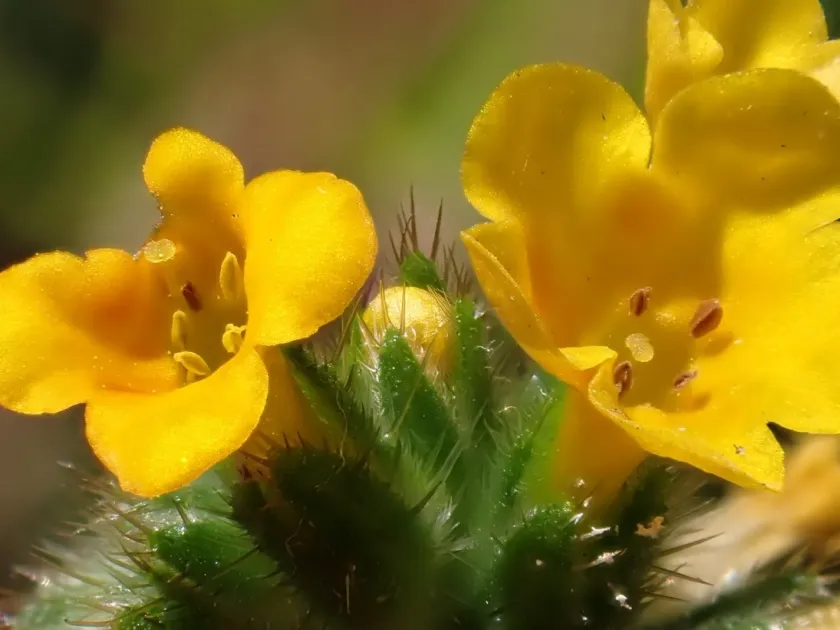
Menzies' fiddleneck (Amsinckia menziesii) is an annual herbaceous weed belonging to the Boraginaceae family. It typically grows to a height of 20 to 60 centimeters, featuring erect or spreading stems.
The plant is densely covered with stiff, bristly hairs that can cause mechanical irritation to human skin upon contact. The leaves are alternate, lanceolate, and sessile, giving the plant a rough texture.
The flowers are arranged in characteristic coiled, fiddle-neck-like racemes. They are small, tubular, and bright yellow to orange, making the plant easily recognizable during the flowering stage.
The fruit consists of four nutlets, which have a rough, tuberculate surface, aiding in their dispersal via farm machinery or animal fur.
Biological cycle includes germination primarily in the autumn and winter months, allowing the plant to establish early and compete effectively with spring-sown crops.
Where it grows
Native to Western North America, this species has become an invasive weed in various temperate regions globally. It is highly adaptable to diverse soil conditions and disturbed sites.
It prefers light, well-drained, sandy or gravelly soils. Menzies' fiddleneck frequently colonizes roadsides, waste areas, and overgrazed pastures, from where it spreads into cultivated fields.
In agricultural settings, it is a significant problem in winter cereal crops, grain legumes, and fallow fields. Its drought tolerance allows it to thrive in arid and semi-arid climates.
The weed is known for its ability to quickly dominate fallow land, forming dense stands that prevent the growth of desirable forage or cover crops.
Its high seed production capacity ensures long-term persistence in the soil seed bank, making complete eradication a challenging and multi-year task.
Harm it causes
The main harm caused by Menzies' fiddleneck is its aggressive competition for water, nutrients, and sunlight, which can significantly reduce crop yields in infested fields.
It poses a serious health risk to livestock. The plant contains pyrrolizidine alkaloids, which are toxic to cattle and horses if consumed, potentially causing severe liver damage or death.
During harvest, the dry, bristly biomass can clog combine harvesters and contaminate the grain sample, increasing cleaning costs and storage moisture levels.
The presence of fiddleneck seeds in crop commodities can lead to quality downgrades, often requiring mechanical seed separation to meet commercial standards.
In high-density infestations, the weed can reduce crop yields by 15-30 percent, depending on the timing of germination and the level of crop competition.
How to control
Effective management requires an integrated approach, starting with crop rotation that involves competing crops and different cultivation practices to break the weed's life cycle.
Mechanical control, such as pre-planting cultivation, is essential to destroy seedlings before the crop emerges. Mowing can prevent seed set if done before flowering.
Chemical control is most effective when applied at the seedling or rosette stage. Selective herbicides targeting broadleaf weeds are typically recommended for cereal crops.
- Deep plowing to bury seeds below the germination depth.
- Using clean, certified seed to prevent the introduction of the weed into new areas.
- Monitoring field borders and ditch banks to stop the spread of seeds into production fields.
Regular scouting is crucial to detect early infestations. Post-emergence herbicide applications should be timed correctly to maximize the impact on the weed while minimizing crop stress.
Taxonomy
- Latin name
- Amsinckia menziesii
- Family
- Бурачниковые
- EPPO code
- AMSME