
Amsinckia lycopsoides
Amsinckia lycopsoides
Description
How to tell it apart
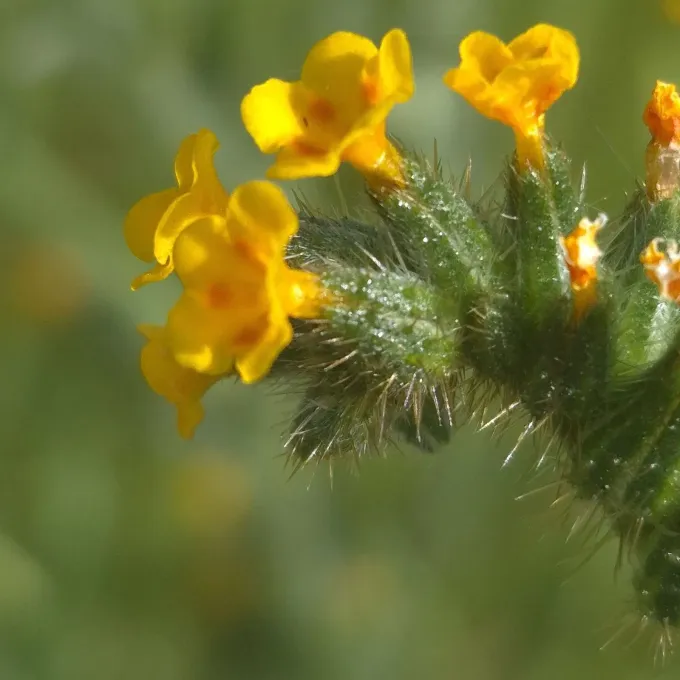
Amsinckia lycopsoides, commonly known as a type of fiddleneck, belongs to the Boraginaceae family. It is an annual herbaceous plant typically growing to a height of 20 to 60 cm.
The entire plant is covered in coarse, stiff hairs that can cause mechanical irritation to the skin upon contact. These hairs also discourage livestock from grazing on the plant.
The leaves are alternate, lanceolate, or oblong, and display a prominent venation pattern similar to other borage family members. In early growth stages, the plant forms a basal rosette.
The flowers are small, bright yellow or orange-yellow, and arranged in dense, coiled spikes. As the plant matures, these spikes elongate into a more distinct fiddle-like shape.
The fruit is a nutlet, usually produced in sets of four. The seeds are rough and textured, which helps them adhere to clothing, animal fur, or machinery for dispersal.
Where it grows
Native to North America, Amsinckia lycopsoides has become a widespread invasive species in many parts of the world, including Europe and Australia, where it thrives in temperate climates.
It favors loose, well-aerated soils and is commonly found in cereal fields, vegetable crops, orchards, and along roadsides, fallow fields, and waste areas.
In agricultural settings, it frequently infests winter and spring cereal crops, as well as legumes. It is highly adaptable and can establish itself in both sandy and rocky soils.
The spread of this weed is largely driven by contaminated seed lots, as the seeds of Amsinckia are often similar in size and weight to those of common agricultural crops.
Its ability to tolerate various environmental conditions allows it to occupy niche habitats where other weeds might struggle, ensuring its continued presence in the landscape.
Harm it causes
The primary impact of Amsinckia lycopsoides on agriculture is its intense competition with crops for water, nutrients, and sunlight, often leading to significant yield losses if left unchecked.
The plant contains alkaloids that are toxic to livestock. Ingestion of contaminated hay or forage can result in poisoning, particularly affecting horses and cattle.
The presence of its seeds in harvested grain reduces the quality and market value of the crop. Cleaning such contaminated grain requires specialized equipment and increases operational costs.
This weed acts as an alternative host for various plant viruses and fungal diseases, which can spread to commercial crops, compromising the overall health of the field.
With its high seed production potential, a single plant can significantly increase the soil seed bank, creating a persistent weed management problem for subsequent growing seasons.
How to control
Effective management begins with mechanical practices such as deep fall plowing, which buries seeds at depths that inhibit germination, and maintaining proper crop rotations.
Timely inter-row cultivation in row crops helps eliminate seedlings before they reach the flowering stage. Controlling weed growth on field edges and ditches is essential to prevent re-infestation.
Chemical control via herbicides is most effective during the early stages of plant growth, specifically when the weed is in the rosette stage before it develops protective hairs.
Selecting appropriate herbicides depends on the crop being protected. Integrated Weed Management (IWM) approaches, combining chemical and non-chemical methods, provide the best results.
- Ensure seed purity before planting.
- Use deep tillage to manage the seed bank.
- Apply selective herbicides during the rosette phase.
- Maintain buffer zones around cropped fields.
Taxonomy
- Latin name
- Amsinckia lycopsoides
- Family
- Бурачниковые
- EPPO code
- AMSLY