
Phacelia purshii
Phacelia purshii
Description
How to tell it apart
Phacelia purshii, commonly known as Miami mist, is an annual plant belonging to the Boraginaceae family. While it is sometimes grown for its ornamental value, in an agricultural context, it is recognized as a persistent weed.
The plant features an erect stem that can reach heights of 20 to 50 cm. The entire plant is covered in coarse, stiff hairs, which gives it a somewhat rough texture to the touch.
Its leaves are arranged alternately along the stem, with lower leaves being petiolate and upper ones sessile. They are typically pinnately lobed or deeply toothed, contributing to the plant's distinctive appearance.
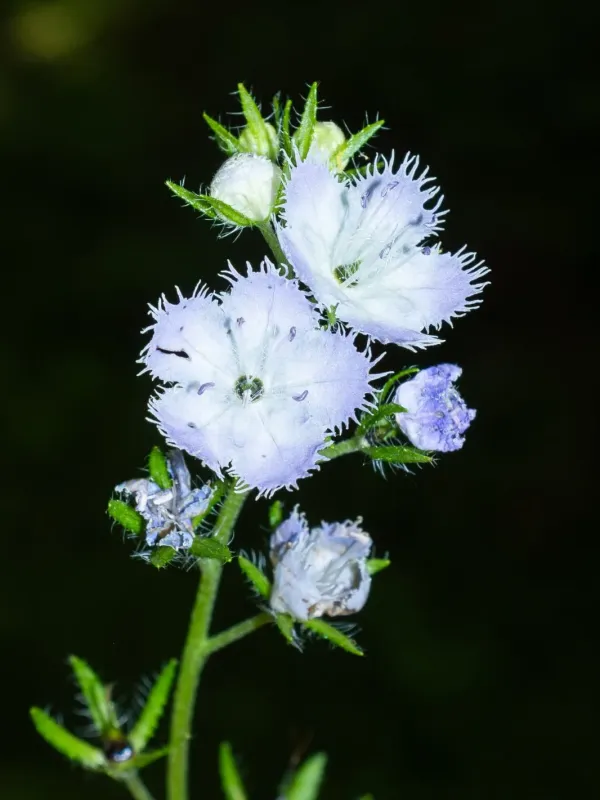
The flowers are arranged in one-sided cymes and possess a bell-shaped corolla. They are usually blue or violet, often displaying striking purple veins that make the plant easily identifiable.
The root system is taprooted, providing the plant with excellent stability and the ability to access water and nutrients from deeper soil layers, even in competitive conditions.
Where it grows
Phacelia purshii thrives in areas with fertile, moist, and well-drained soils. It is frequently found in fields, forest edges, and along roadsides where light levels are relatively high.
In agricultural settings, it commonly infests grain fields and open-row crop plantations. It takes advantage of gaps in crop canopy caused by poor germination or uneven planting.
The species is highly adaptable and can establish itself in various soil types, ranging from loams to rich black soils, making it a widespread nuisance in many regions.
Once established in a field, the weed spreads rapidly, especially if cultivation practices are infrequent, allowing it to complete its life cycle before harvest.
Seed dispersal is facilitated by wind and human activities, including the movement of farm machinery and the use of contaminated agricultural products.
Harm it causes
The primary damage caused by Phacelia purshii is resource competition. It efficiently absorbs moisture and nutrients that would otherwise be available to the crops.
By competing for sunlight in the early growth stages, the weed can stunt the development of crop seedlings, leading to reduced final yields and poor stand density.
The presence of this weed at harvest time creates mechanical difficulties. The dense foliage can clog harvesting equipment, leading to increased wear and tear and slower processing speeds.
Furthermore, Phacelia purshii serves as a host for various insects and pathogens, which can migrate to crops, increasing the overall phytosanitary risk on the farm.
- Reduced crop yield potential.
- Higher costs for post-harvest grain cleaning.
- Increased dependency on chemical interventions.
How to control
Effective management begins with proper crop rotation, which breaks the life cycle of the weed and reduces the accumulation of seeds in the soil seed bank.
Mechanical control through deep plowing and timely cultivation is highly effective. These practices bury seeds deep enough to prevent germination and uproot established plants.
In row crops, mechanical inter-row cultivation is a standard and recommended practice to disrupt the root systems of the weed throughout the growing season.
Chemical control via selective herbicides is necessary for high-infestation levels. Application should ideally be timed when the weeds are in the early seedling stage.
Maintaining high hygiene standards for agricultural equipment and using high-quality, certified seeds are crucial preventative measures to keep fields clean.
Taxonomy
- Latin name
- Phacelia purshii
- Family
- Бурачниковые
- EPPO code
- PHCPU