
Phacelia minor
Phacelia minor
Description
How to tell it apart
Phacelia minor belongs to the Boraginaceae family. While some species of Phacelia are prized for honey production, Phacelia minor is often considered a troublesome weed in agricultural settings due to its aggressive growth.
The plant is characterized by glandular hairs on its stems and leaves, which make the entire plant feel sticky. The leaves are alternate and deeply lobed, contributing to its distinct appearance compared to nearby crops.
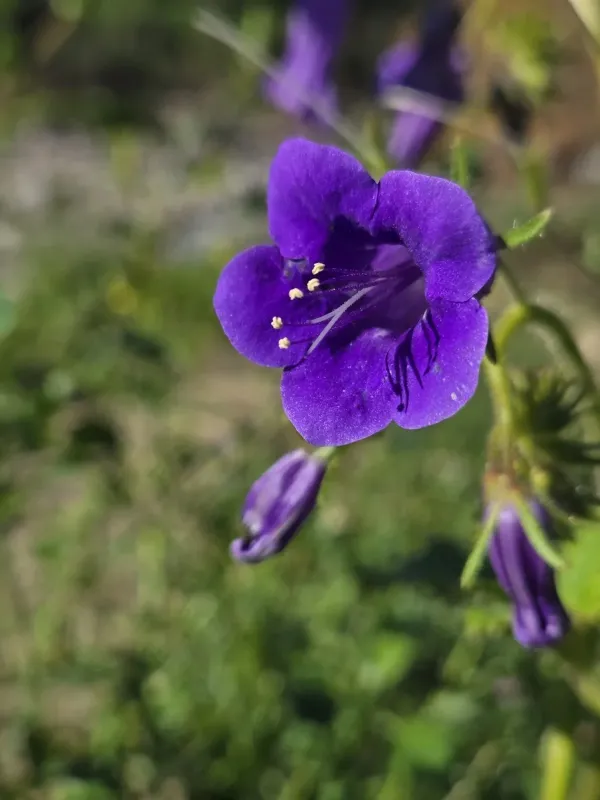
Its flowers are arranged in curled cymes, typical of the Boraginaceae family. The corolla is bell-shaped and usually displays vibrant blue or violet hues, which makes it highly visible during its blooming phase.
It possesses a strong taproot system that allows the plant to thrive in various conditions and compete effectively for soil moisture. It reproduces primarily through the production of numerous small seeds.
The biological strategy of Phacelia minor includes rapid early-season growth, which allows it to establish dominance in fields before the main crops have fully developed.
Where it grows
Phacelia minor prefers open areas with well-drained, sunny soils. It is commonly found on fallow land, along roadsides, and in unmanaged field margins, which serve as reservoirs for future infestations.
In farming, it frequently invades row crops such as sunflowers, corn, and sugar beets. It can also cause significant issues in grain fields if the soil preparation and planting techniques are inadequate.
The plant demonstrates high ecological plasticity, enabling it to adapt to diverse climatic zones. It readily colonizes disturbed soils where competitive pressure from crops or other vegetation is low.
The presence of this weed often serves as a signal that crop rotation protocols or pre-planting tillage practices have been suboptimal. It thrives in well-aerated soils and struggles in heavily shaded environments.
The species is capable of establishing dense patches in productive areas, gradually expanding its territory and displacing desirable plant species through efficient nutrient uptake.
Harm it causes
The primary damage caused by Phacelia minor is its intense competition for soil moisture and essential mineral nutrients, which can lead to significant yield losses in commercial crops.
By developing a dense canopy, the weed shades out the developing crop seedlings, causing them to become stunted, weak, and more susceptible to environmental stress and diseases.
The sticky, glandular foliage can obstruct agricultural machinery during planting, cultivation, and harvesting operations, leading to decreased efficiency and potential mechanical damage.
Phacelia minor acts as a reservoir for certain agricultural pests and plant pathogens, increasing the overall phytosanitary burden on the field and necessitating additional management interventions.
The economic impact is compounded by the costs of herbicide applications and the potential for crop contamination, which reduces the market value of the harvested yield.
How to control
Effective agricultural management involves consistent crop rotation and deep autumn plowing, which buries seeds and prevents them from germinating in the following season.
Mechanical control through timely inter-row cultivation is highly effective in row crops, particularly when performed before the weed reaches the flowering stage and begins to set seed.
Chemical control strategies utilize selective herbicides that target broadleaf weeds. Application timing is critical, with the best results achieved when the weed is in the seedling or early rosette stage.
Integrated management plans should include the maintenance of field perimeters to prevent the migration of seeds from adjacent uncultivated areas into the main production zone.
- Timely use of systemic herbicides at early growth stages.
- High-quality pre-planting tillage to eliminate young weeds.
- Management of field margins to reduce seed banks.
- Using high-quality, weed-free crop seeds for planting.
- Regular field scouting to detect and treat patches early.
Taxonomy
- Latin name
- Phacelia minor
- Family
- Бурачниковые
- EPPO code
- PHCMI