
Phacelia linearis
Phacelia linearis
Description
How to tell it apart
Phacelia linearis, commonly known as threadleaf phacelia, belongs to the Boraginaceae family. It is an annual herbaceous plant typically growing to a height of 10 to 40 centimeters with a distinct upright or branched stem.
The leaves are characteristically linear or lanceolate in shape, growing alternately along the stem. They can be entire or slightly lobed, which serves as a primary visual marker for identification in the field.
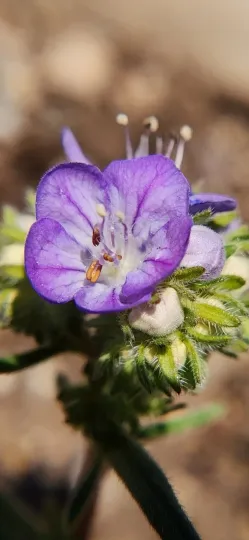
The flowers are arranged in dense, coiled or spiked inflorescences. The corolla is typically bell-shaped or funnel-shaped and exhibits colors ranging from pale lavender to deep blue or violet.
It possesses a taproot system that allows the plant to anchor effectively and survive in dry conditions. This robust root structure makes it a resilient competitor against crop species.
The seeds are small and possess high viability, allowing the species to persist in the soil seed bank for several years, which complicates long-term management.
Where it grows
Phacelia linearis is native to western North America, typically found in open meadows, dry rocky slopes, and disturbed areas where light competition is minimal.
As a weed, it thrives in agricultural fields with loose, well-drained soils. It frequently appears along field margins, roadsides, and in grain crops that have failed to achieve a uniform canopy.
The plant is highly adaptable to various soil textures, including sandy and loamy conditions, provided that the location is sufficiently exposed to sunlight.
Its spread is largely driven by wind dispersal of seeds and the movement of agricultural machinery, which transports seeds from infested patches to pristine areas.
Because it is intolerant of dense shade, Phacelia linearis often establishes itself early in the season before the crop canopy closes, giving it a head start in growth.
Harm it causes
The primary agricultural impact of Phacelia linearis is its competition for vital resources, including soil moisture, nitrogen, and phosphorus, which directly stunts the growth of adjacent crops.
High densities of this weed lead to significant yield reductions, especially in crops like wheat or barley, where the weed occupies the same niche as the grain.
The presence of the weed increases harvesting difficulties, as the green biomass adds moisture to the harvested grain, potentially triggering the need for expensive post-harvest drying.
Furthermore, Phacelia linearis may serve as an alternative host for various agricultural pests and viral diseases that can easily transmit to commercial crops.
The contamination of grain with weed seeds results in additional processing costs and may downgrade the commercial value of the harvested produce due to purity standards.
How to control
Effective management begins with mechanical control, specifically deep tillage, which buries seeds deep enough to inhibit germination and exhausts the soil seed bank.
Implementing a rigorous crop rotation strategy helps to suppress the weed by alternating between crops that differ in their growth habits and herbicide requirements.
Mechanical cultivation between crop rows remains an essential tool for farmers to destroy weed seedlings before they reach the flowering stage and produce new seed.
Chemical control involves the use of selective herbicides applied at the rosette stage or early branching stage, when the weed is most susceptible to active ingredients.
- Utilize high-quality, certified weed-free seed for planting.
- Sanitize farm equipment after working in infested fields to prevent seed spread.
- Implement timely mowing of field edges to eliminate seed production before it occurs.
Taxonomy
- Latin name
- Phacelia linearis
- Family
- Бурачниковые
- EPPO code
- PHCLI