
Phacelia distans
Phacelia distans
Description
How to tell it apart
Phacelia distans, commonly known as common phacelia or distant phacelia, is an annual herb belonging to the Hydrophyllaceae family. It is distinguished by its pinnately divided leaves with segments spaced noticeably apart.
The stems are typically erect or ascending, reaching heights of 20 to 60 centimeters, and are covered with stiff, bristly hairs that help the plant tolerate dry environmental conditions.
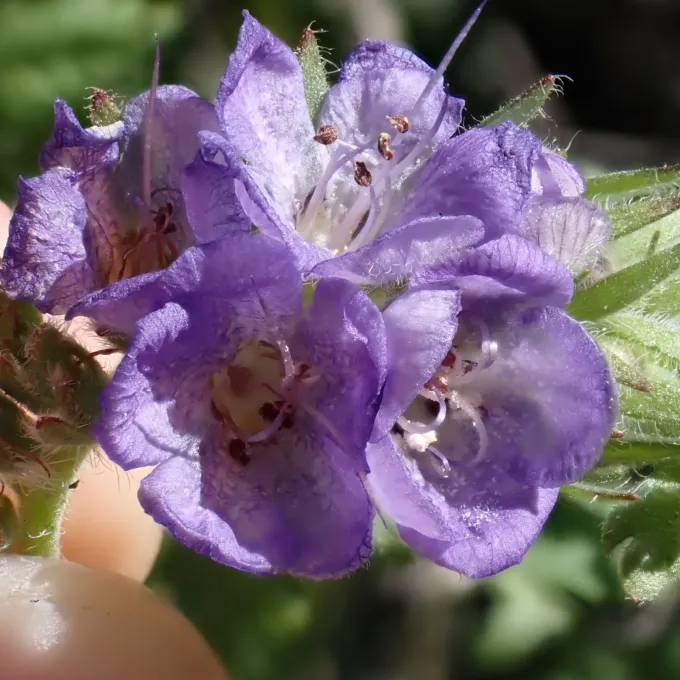
The inflorescences are distinctive coiled cymes featuring small, bell-shaped flowers ranging from blue to violet or whitish. Long, protruding stamens give the flowers a characteristic fuzzy appearance.
This species produces abundant seeds contained in small capsules, which possess high longevity and can persist in the soil seed bank for several years, ensuring consistent germination.
It possesses a deep taproot system, which allows the plant to access moisture and nutrients deep within the soil profile, making it a highly competitive weed in agricultural settings.
Where it grows
Phacelia distans is native to western regions of North America, where it thrives in arid to semi-arid environments, such as dry slopes, plains, and disturbed sites.
The plant prefers well-drained, sandy, or rocky soils and is frequently found along roadsides, abandoned agricultural lands, and overgrazed pastures.
In farming systems, it acts as a troublesome weed that invades grain fields, orchards, and legume crops, especially in regions with limited rainfall where it outcompetes crops.
It is often among the first species to colonize bare ground after mechanical disturbance or fire, quickly establishing dense populations due to its rapid life cycle.
Its ability to adapt to varying soil conditions makes it a widespread nuisance in both irrigated and dryland agricultural practices.
Harm it causes
The primary impact of Phacelia distans on agriculture is direct resource competition, particularly for water and soil nutrients, which can significantly reduce crop yield and quality.
Its high seed production capacity leads to rapid field infestation, increasing the economic burden on farmers who must manage the persistent soil seed bank over multiple seasons.
The stiff, glandular hairs on the foliage make the plant unpalatable and potentially irritating to grazing livestock, thereby reducing the carrying capacity of pastures.
The weed can act as an alternative host for various pests and plant pathogens, facilitating the infection of adjacent commercial crops during the growing season.
Contamination of the harvested grain with seeds or foliage from Phacelia distans incurs extra cleaning costs and may result in the rejection of produce due to quality standards.
How to control
Cultural control strategies include timely deep tillage, which buries seeds too deep for successful germination and destroys established plants before they reach the flowering stage.
Mechanical weed control, such as inter-row cultivation in row crops, is highly effective in removing young seedlings before they develop a deep taproot system.
Integrating crop rotation practices that vary the planting and harvest schedules can disrupt the life cycle of the weed and minimize its buildup in the soil.
Chemical control is an important tool, utilizing selective broadleaf herbicides applied during the early vegetative growth stages of the weed to maximize efficacy.
Always adhere to local agricultural regulations and label instructions when applying herbicides to ensure safety for the main crop and minimize environmental impact.
Taxonomy
- Latin name
- Phacelia distans
- Family
- Бурачниковые
- EPPO code
- PHCDI