
Onosmodium virginianum
Onosmodium virginianum
Description
How to tell it apart
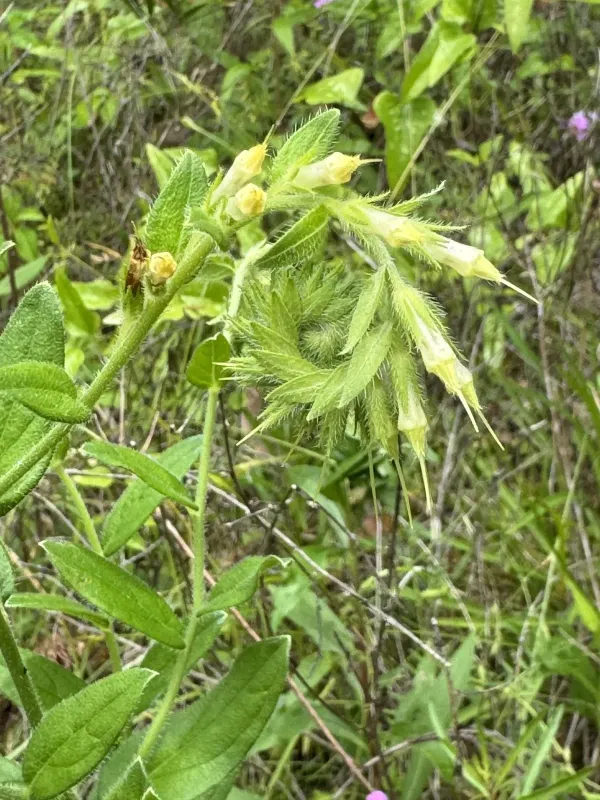
Onosmodium virginianum, commonly known as soft-hairy marbleseed, belongs to the Boraginaceae family. It is a perennial herbaceous plant distinguished by its coarse, stiff pubescence on stems and leaves.
The stems grow erect and often branch near the top, reaching heights between 30 and 80 cm. The leaves are alternate and lanceolate, covered in prominent hairs that give the plant a grayish-green appearance.
Flowers are arranged in leaf-bearing cymes that elongate as the seeds mature. The corolla is tubular-bell-shaped and usually pale yellow or creamy white, with noticeable stamens protruding.
The root system consists of a robust, deep-penetrating taproot, which allows the plant to survive harsh environmental conditions, including extended periods of drought.
The fruit is an ovoid nutlet, which is smooth and glossy. These seeds have a high level of dormancy and can persist in the soil for multiple seasons, facilitating weed expansion.
Where it grows
Native to North America, this plant typically thrives in open, sunny environments. It is frequently found on dry meadows, forest edges, and rocky slopes in its natural state.
As a weed, it frequently colonizes anthropogenically disturbed areas, such as roadside verges, neglected pastures, and the margins of agricultural fields where tillage is limited.
It poses a threat to perennial crops and fallow lands. Its ability to propagate via seeds that disperse easily ensures rapid colonization of newly cleared or disturbed ground.
The species shows a preference for sandy or gravelly soils with neutral to slightly acidic pH levels but is highly adaptable to various soil textures provided there is sufficient light.
In regions where it acts as an invasive species, it forms dense colonies that can outcompete native vegetation and interfere with the management of agricultural landscapes.
Harm it causes
The primary harm caused by Onosmodium virginianum is its intense competition for water and soil nutrients, particularly in early-stage crops where moisture is a limiting factor.
Due to its deep taproot, the plant continues to extract water from lower soil horizons even when topsoil moisture is depleted, stressing surrounding crops during dry spells.
The stiff, harsh hairs on the foliage make the plant unpalatable to livestock, which can lead to its dominance in grazed pastures if left unchecked by selective management.
In cultivated fields, the plant shades out seedlings and competes for space, leading to significant yield reductions if the infestation is dense and persistent.
The accumulation of a seed bank in the soil creates a long-term management challenge, requiring continuous surveillance and intervention for several consecutive years.
How to control
Deep autumn plowing is the most effective mechanical control method, as it severs the taproot system and significantly hinders the regrowth of the perennial plant.
Regular discing or cultivation during the vegetative phase, performed prior to seed set, is essential to exhaust the plant's carbohydrate reserves stored in the root system.
Chemical control usually involves the application of systemic herbicides such as glyphosate on fallow fields or as pre-plant burndown treatment to eradicate established stands.
For selective control in growing crops, agronomists recommend using herbicides that target dicotyledonous weeds, though effectiveness may vary depending on the plant's maturity.
An integrated weed management approach, which combines crop rotation, mechanical disruption of roots, and targeted chemical applications, provides the most sustainable control.
Taxonomy
- Latin name
- Onosmodium virginianum
- Family
- Бурачниковые
- EPPO code
- ONMVI