
Hackelia diffusa
Hackelia diffusa
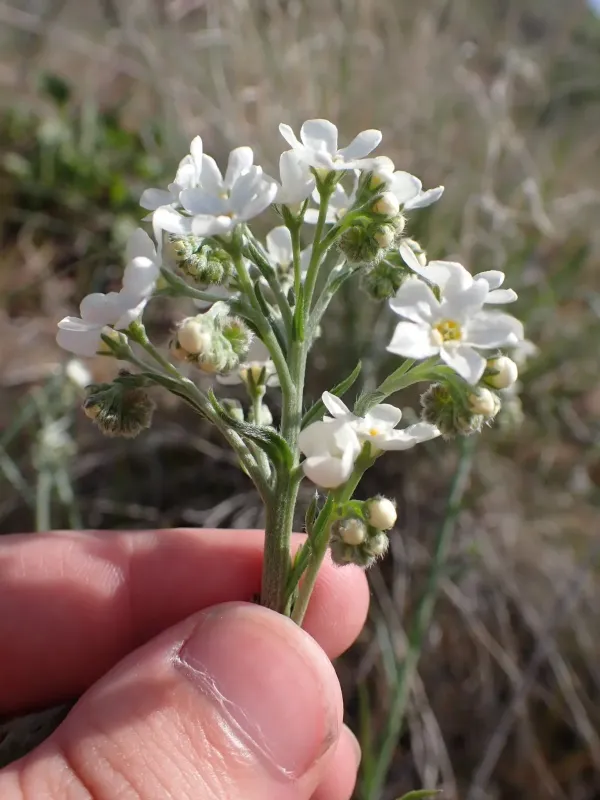
Description
How to tell it apart
Hackelia diffusa, commonly known as a type of stickseed, belongs to the Boraginaceae family. It is a biennial or perennial herb with a robust taproot system.
During its first year, the plant develops a basal rosette of leaves. In the second year, it produces a branching stem that can grow significantly in height.
The leaves and stems are typically covered in stiff hairs, which is a hallmark of many plants within the borage family.
Flowers are small, arranged in characteristic coiled racemes or cymes, usually exhibiting white to pale blue petals depending on the specific growing environment.
The seeds are notable for their hooked prickles, which are evolutionarily adapted to adhere to fur or clothing, facilitating widespread dispersal across agricultural fields.
Where it grows
This species is native to North America, typically found in rocky slopes, gravelly areas, and open, dry environments where competition from taller plants is limited.
In agricultural settings, it often invades disturbed soil, roadsides, and the edges of cultivated fields, gradually spreading into the main crop areas.
It thrives in well-drained, sandy, or rocky soils that maintain low moisture content, making it a persistent weed in specific ecological niches.
It is capable of colonizing abandoned agricultural land quickly, often acting as a pioneer species on sites with limited vegetation cover.
Modern farming practices that involve reduced tillage can sometimes encourage the establishment of this weed if appropriate management is not followed.
Harm it causes
Hackelia diffusa competes intensely with crop plants for essential nutrients and limited soil moisture, leading to significant yield reductions.
In pastures, the barbed seeds represent a physical nuisance to livestock, causing irritation and degrading the quality of wool or hides.
The weed acts as a potential host for various pests and diseases that can cross-infect economically important agricultural crops.
Its high seed production capacity ensures that once established, it can rapidly dominate a field if not controlled in its early growth stages.
Contamination of harvested grain with stickseed seeds often incurs additional processing costs to meet market quality standards.
How to control
Cultural control strategies focus on mechanical tillage, which helps destroy basal rosettes and prevent the plant from reaching its seed-bearing stage.
Crop rotation remains a highly effective method to disrupt the life cycle of the weed by alternating between competitive crop species.
Timely mowing or discing of field borders and adjacent non-crop areas is essential to prevent the spread of seeds into the cultivated field.
Chemical control involving selective herbicides applied during the vegetative growth stage of the rosette provides the most consistent results.
- Deep plowing to bury seeds
- Application of selective post-emergence herbicides
- Maintaining healthy crop density to shade out seedlings
Taxonomy
- Latin name
- Hackelia diffusa
- Family
- Бурачниковые
- EPPO code
- HACDI