

Description
How to tell it apart
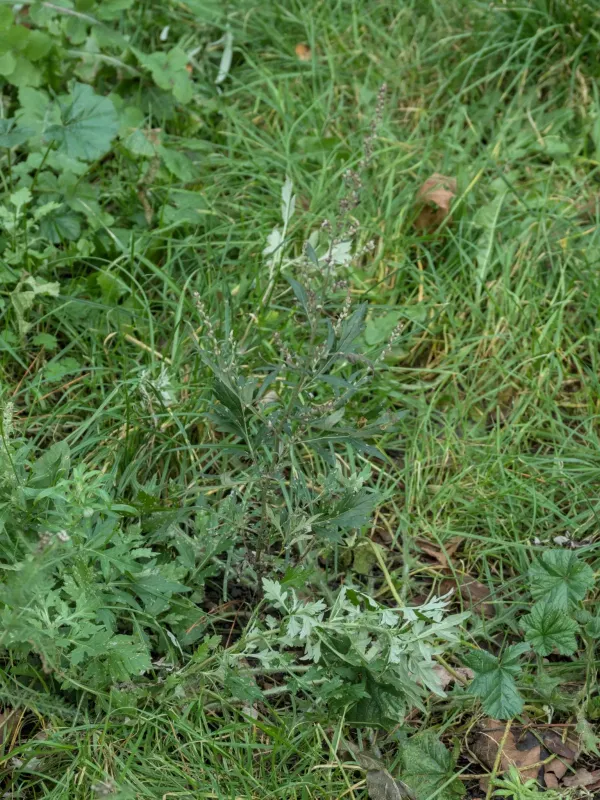
Mugwort (Artemisia vulgaris) is a perennial plant in the Asteraceae family, characterized by a tough, creeping rhizome system that allows it to persist in various soil conditions.
The stems are erect, ribbed, often tinged with purple or red, and can reach heights of up to 1.5 meters, branching out extensively at the top during the flowering phase.
Its leaves are deeply lobed and exhibit a striking contrast: the upper surface is dark green and smooth, while the underside is covered in dense, white-gray felt-like hairs.
The plant produces small, inconspicuous reddish-brown or yellow flower heads arranged in dense, plume-like panicles that appear from mid-summer through early autumn.
Reproduction is primarily vegetative via underground rhizome segments, which can regenerate even if the plant is cut, but it also spreads effectively through wind-dispersed seeds.
Where it grows
Mugwort is highly adaptable and can be found growing along roadsides, in waste areas, riverbanks, and degraded agricultural landscapes across temperate regions.
It favors fertile, well-drained soils but is equally capable of establishing itself in compacted or disturbed ground where native vegetation has been suppressed.
In agricultural settings, it is commonly found on field borders, fencelines, and in perennial crop fields where tillage practices are infrequent or superficial.
The weed thrives in areas that are not regularly plowed, making orchards, berry plantations, and long-term pastures particularly susceptible to colonization.
Mugwort often persists in fields where the crop rotation cycle has been poorly managed, allowing perennial weeds to build up significant underground biomass.
Harm it causes
As a strong competitor, mugwort depletes soil moisture and essential nutrients, depriving crops of the resources required for optimal growth and yield potential.
The plant exhibits allelopathic properties, releasing chemical substances into the soil that inhibit the germination and development of nearby crop plants.
Mugwort acts as an alternative host for various agricultural pests and pathogens, potentially increasing the pressure of diseases like mildew in nearby crop stands.
Its dense growth and tall stature lead to severe shading, reducing light penetration to the canopy of lower-growing crops and causing weak, etiolated development.
Harvesting efficiency is significantly reduced in infested fields due to biomass volume, and the presence of vegetative debris can contaminate grain, affecting final quality.
How to control
Effective management of mugwort requires a persistent strategy, as its deep rhizomes allow it to recover rapidly from partial mechanical injury or improper tillage.
Mechanical control includes deep primary tillage that serves to bring rhizomes to the surface to dry out, followed by repeated harrowing to exhaust the plant's energy reserves.
In no-till or reduced-tillage systems, the use of systemic non-selective herbicides such as glyphosate is necessary during the post-harvest period to ensure translocation into the roots.
For selective control in growing crops, herbicides targeting broadleaf weeds can suppress growth, but these must be applied when the weed is in a susceptible vegetative stage.
Long-term success depends on integrating cultural practices, such as competitive crop rotation or cover cropping, to starve the weed of light and space over several seasons.
Content graph
Connections · Mugwort
Most often together:
Marketplace
Products · 11

Biceps Guarant
ЗАТ Фірма Август, Росія.,селище Вурнари,
Herbicides
0
0
·
2.4K
7 offers
0.63 €per 1 l
Buy



Flagman
«Нанджин Ессенс Файн-Кемікал Ко. Лтд» (Китай)
Herbicides
0
0
·
1.2K
4 offers
9.61 €per 1 l
Buy


Biology
Taxonomy
- Latin name
- Artemisia vulgaris
- Family
- Многолетние двудольные