
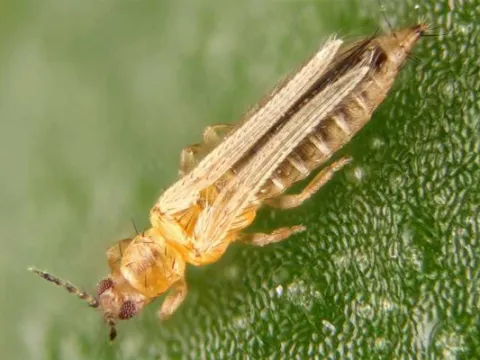
Western flower thrips
Thrips imaginis
Western flower thrips (Thrips imaginis) are minute, slender insects belonging to the order Thysanoptera. Adults are typically about 1.0–1.5 mm long, ranging in color from pale yellow to dark brown, with two pairs of narrow, fringed wings.
What the section contains
Western flower thrips
The larvae are wingless, smaller than adults, and usually yellowish or orange in color. They are highly mobile and tend to congregate in sheltered areas, such as developing flower buds or deep inside the plant foliage.
For accurate identification, professional agronomists use a 10x or 20x hand lens. The insects can be distinguished by their rapid, erratic movement and their tendency to jump when disturbed, which is characteristic of the Thripidae family.
These insects are well-adapted to varied environments and exhibit high fecundity. Females deposit eggs directly into plant tissues, which provides protection for the developing offspring and makes early detection particularly difficult.
Because they are polyphagous, they can be found on a vast array of ornamental, fruit, and vegetable plants, making them one of the most common and persistent pests in professional horticulture worldwide.
Western flower thrips cause significant damage by piercing plant cells and sucking the contents. This feeding behavior destroys individual cells, resulting in localized tissue death and typical silvering or bronzing of the foliage.
Flowers are especially susceptible; feeding leads to distorted, discolored petals, often causing buds to fail to open properly. In fruit crops, feeding during early development results in aesthetic scarring and deformities that significantly lower market value.
Beyond direct feeding damage, thrips are primary vectors for several critical plant viruses, most notably the Tomato Spotted Wilt Virus (TSWV). This viral transmission often causes more severe economic loss than the physical feeding damage itself.
Plants infested with large numbers of thrips show stunted growth, reduced vigor, and increased susceptibility to secondary infections by bacteria and fungi, which thrive in the damaged, necrotic tissues.
In high-density populations, total crop failure is possible if management interventions are not implemented quickly, as the insects can multiply rapidly in a very short span of time.
The population growth of Thrips imaginis is highly dependent on temperature and humidity. Warm, dry weather conditions provide an ideal environment for their development, accelerating their reproductive cycles.
Under optimal conditions, the life cycle from egg to adult can be completed in as little as 10 to 15 days, allowing multiple generations to occur during a single growing season.
They survive the winter in soil, plant debris, or protected structures. As temperatures rise in the spring, the adults emerge and begin to migrate toward emerging host plants, marking the start of the primary infestation cycle.
In greenhouse settings, these pests can thrive year-round if temperatures remain stable. Without strict climate control and monitoring, a greenhouse population can persist indefinitely, posing a constant threat to new plantings.
Late summer and early autumn often see a surge in thrips populations as they seek new food sources or move into protected locations to prepare for the overwintering period.
The first signs of infestation often appear as tiny, silvery stippling on the upper surface of leaves. As the infestation progresses, these areas coalesce into larger patches of gray or brownish necrotic tissue.
Visual observation of blossoms often reveals the insects hiding in the folds of petals. The presence of tiny black spots of frass (excrement) on the petals is a tell-tale sign of active thrips feeding.
- Silvery-white streaks or spots on leaves.
- Deformation or curling of buds and flowers.
- Scarring or scabbing on young fruit surfaces.
- Presence of small, active larvae inside floral structures.
- Premature wilting and yellowing of foliage.
A simple field test for monitoring is the "tap test," where a flower head is tapped over a sheet of white paper. The insects will dislodge and can be easily counted against the white background.
Advanced stages of infestation show significant damage to plant tips and terminal buds, which may become withered, twisted, and brittle, drastically reducing the overall structural integrity of the plant.
Integrated Pest Management (IPM) is essential for effective control. Cultural practices, such as removing weeds that host thrips and properly managing crop residues, significantly reduce the initial population pressure.
Blue sticky traps are widely used in greenhouses as a primary tool for monitoring populations. These traps help agronomists determine the timing of interventions, which is critical for preventing an outbreak.
Biological control agents, including predatory mites (Amblyseius cucumeris) and minute pirate bugs (Orius spp.), are highly effective in suppressing thrips populations when introduced early in the season.
Chemical control should rely on systemic insecticides. Because thrips often hide in tight flower buds where contact sprays cannot reach, systemic products absorbed into the plant tissues provide more reliable protection.
To prevent the development of insecticide resistance, it is crucial to rotate products with different modes of action (MOA) and to avoid reliance on a single chemical class throughout the season.