
Yellow tea thrips
Scirtothrips dorsalis
Description
How to identify
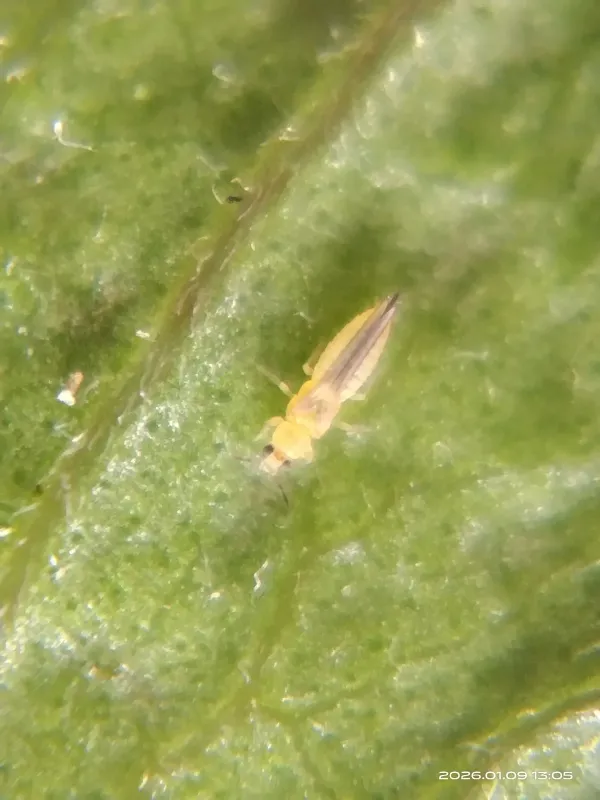
The yellow tea thrips (Scirtothrips dorsalis) is a tiny insect belonging to the order Thysanoptera and the family Thripidae. Adults are approximately 1–1.2 mm long and possess a pale yellow to straw-colored body.
The body is elongated with two pairs of narrow wings featuring long fringe hairs, which is a key diagnostic characteristic. They have eight-segmented antennae and dark compound eyes.
Larvae are similar in shape to adults but are smaller, wingless, and have a translucent or pale white appearance, making them difficult to spot on foliage.
The life cycle progresses through eggs, two larval stages, prepupa, pupa, and adult. At optimal temperatures of 25–30°C, the complete life cycle lasts about 15–20 days, facilitating rapid population growth.
This species is highly adaptable and can establish populations in diverse environments, ranging from tropical regions to climate-controlled greenhouses in temperate zones.
What it damages
This pest is highly polyphagous, attacking over 250 plant species across various families, including critical food, fiber, and ornamental crops.
Major host plants include peppers, tomatoes, eggplants, cucumbers, citrus, grapes, strawberries, and various ornamental flowers such as roses.
Feeding occurs by rasping the plant epidermis and sucking the exuded cell contents, which disrupts normal plant physiological processes and weakens the host.
Beyond direct damage, Scirtothrips dorsalis acts as an important vector for various plant viruses, such as the peanut necrosis virus and tomato spotted wilt virus.
Heavy infestations in greenhouse settings cause severe economic loss through fruit deformation, stunted growth, and significantly reduced marketability of harvested produce.
Signs of infestation
Initial symptoms often appear as fine silvery or bronze patches on the undersides of leaves, which eventually coalesce into larger necrotic or chlorotic areas.
Leaves may curl, become distorted, and drop prematurely. Terminal shoots often show reduced elongation, leading to stunted plant development and a bushy appearance.
Fruit damage is frequently characterized by corky scabbing, scarring, or a distinctive net-like pattern, rendering the produce unappealing for consumers.
Presence of the pest can be confirmed by inspecting flowers or the undersides of young leaves where adults and larvae cluster, often accompanied by tiny black fecal spots.
- Silvery-bronze patches on foliage.
- Deformed fruit with corky scabbing.
- Leaf curling and stunted shoot growth.
- Premature leaf drop.
- Presence of tiny insects in flower buds.
Control measures
Strict quarantine and phytosanitary inspections are the first line of defense to prevent the introduction of this pest through imported plant material or produce.
Monitoring within greenhouses is essential, utilizing blue or yellow sticky traps to detect initial infestations before they reach damaging levels.
Cultural management involves rigorous sanitation, including the removal of weeds that serve as alternative hosts and the destruction of crop residues post-harvest.
Biological control programs often utilize predatory mites like Amblyseius swirskii and predatory bugs like Orius species to naturally suppress thrips populations.
Chemical control should be employed judiciously, focusing on systemic insecticides while rotating active ingredients to mitigate the risk of resistance development in the population.
Taxonomy
- Latin name
- Scirtothrips dorsalis
- Order
- Thrips
- Family
- Thripidae
- EPPO code
- SCITDO
Discussion
No discussions yet — be the first.