
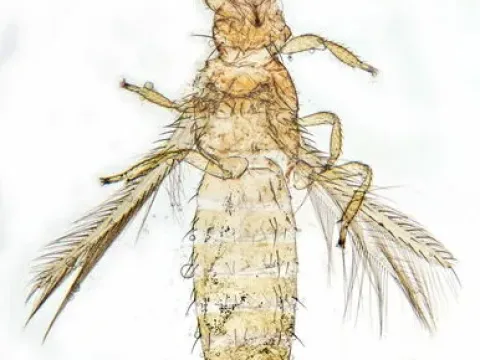
Yellow thrips
Thrips flavus
Yellow thrips (Thrips flavus) is a member of the order Thysanoptera and the family Thripidae. These are tiny insects, typically measuring between 1 to 1.5 mm in length.
What the section contains
Yellow thrips
The body color of the adults ranges from pale yellow to golden-brown. They possess two pairs of narrow wings, each fringed with long hairs, which enable them to move effectively throughout the host plant.
The larvae resemble adults in shape but are smaller, wingless, and translucent, often making them very difficult to detect during the early stages of a plant infestation.
The life cycle consists of egg, two larval stages, propupa, pupa, and adult. They undergo an incomplete metamorphosis, with some developmental stages occurring within the soil.
Due to their ability to reproduce through parthenogenesis, populations of yellow thrips can expand rapidly in optimal environmental conditions, posing a significant challenge to growers.
This species is a polyphagous pest, meaning it attacks a wide variety of agricultural crops, including vegetables, fruits, berries, and ornamental plants.
Both adults and larvae cause damage by piercing the plant cells and sucking out the contents. This feeding activity disrupts photosynthesis and weakens the overall vigor of the host plant.
Feeding typically occurs on young leaves, buds, and flowers, which often results in severe deformation, stunted growth, and a significant reduction in market value.
Severe infestations can cause flowers to wither, buds to fail to open, and fruits to become scarred or discolored, rendering them unsuitable for sale.
In addition to direct physical damage, Thrips flavus can serve as a vector for various plant viruses, which can be devastating to field and greenhouse crop production.
The activity of yellow thrips is highly dependent on temperature. In the field, they become active when temperatures rise above 12–15 degrees Celsius in the spring.
In greenhouses and indoor environments, yellow thrips can remain active throughout the year, with multiple generations developing rapidly under controlled climate conditions.
Population outbreaks are most common during hot and dry weather. Under these conditions, the life cycle of a single generation can be as short as 10–14 days.
During the winter, yellow thrips typically overwinter as adults in the soil, among plant debris, or in protected structures such as greenhouse cracks and crevices.
When environmental conditions become unfavorable, such as during autumn or late winter, the insects enter a state of diapause, waiting for the return of warmer weather.
Initial signs of infestation appear as small, white or silvery patches on the surface of the leaves, which eventually merge into larger, metallic-looking damaged areas.
When inspecting the underside of the foliage, one can often see the tiny larvae crawling around, as well as small black spots, which are the excrement of the insects.
Affected buds often fail to bloom, and the flowers that do open are frequently deformed or show stunted growth, impacting the visual appeal of ornamental plants.
Infected plants may exhibit stunted growth, yellowing foliage, and premature leaf drop as the overall health of the plant declines due to nutrient loss.
- Appearance of silvery, chlorotic spots on leaves.
- Distortion and curling of new shoots and flower buds.
- Presence of sticky residues and small black excrement dots.
- Premature dropping of petals or damaged pollen sacs.
- General plant wilting and loss of vitality.
Managing yellow thrips requires an integrated pest management (IPM) approach that combines cultural practices, biological controls, and chemical interventions.
Cultural methods include removing weeds that serve as alternative hosts, deep plowing of soil to disrupt overwintering sites, and maintaining good sanitation within the crop area.
Biological control involves the introduction of natural predators, such as predatory mites (e.g., Amblyseius spp.) or minute pirate bugs, which feed on thrips larvae.
Chemical control may be necessary if infestation levels are high. It is crucial to rotate insecticides with different modes of action to prevent the development of pesticide resistance.
Monitoring using yellow sticky traps is a standard and essential practice, allowing for the early detection of thrips populations before they cause significant economic damage.