
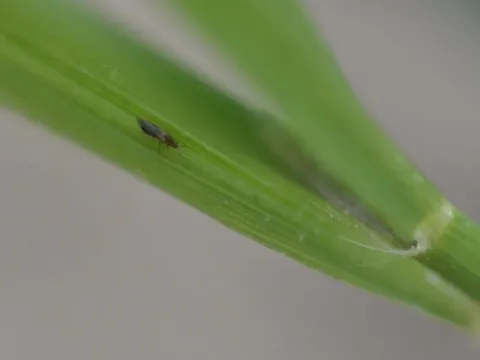
Grain thrips
Stenothrips
The grain thrips (Latin Stenothrips graminum) belongs to the order Thysanoptera and the family Thripidae. The adult insect has an elongated body about 1 mm long, colored in brownish-yellow or brown shades.
What the section contains
Grain thrips
The larvae of the pest resemble the adults in appearance but are smaller and have a lighter, yellowish color. They are wingless and feed actively throughout their entire development period.
The wings of the adult insect are narrow, with a characteristic fringe of long hairs, which is a typical feature of this order. The mouthparts are of the piercing-sucking type, adapted for feeding on plant cell sap.
The life cycle includes an egg, two larval stages, a propupa, a pupa, and an adult. In temperate climates, there is usually one generation per year, which is synchronized with the seasonal growth of cereal crops.
Adults hibernate in the soil, mainly in the upper layer, under plant residues, or in cracks in the ground in fields where cereals were grown in the previous season.
The primary food source for the grain thrips is agricultural crops of the Poaceae family. Barley is most frequently affected, although the pest can also be found in wheat, oats, and rye fields.
In addition to cultivated plants, the species can inhabit various types of wild grasses, which serve as intermediate hosts during periods when the main food source is absent in the fields.
Damage is caused by both adult insects and larvae, which suck juices from leaves, stems, and, most critically, from developing ears during the heading and grain-filling stages.
Particular danger arises from damage to the flag leaf and glumes, which disrupts the normal process of photosynthesis and the translocation of nutrients to the grain kernel.
High population density in a field can lead to significant yield reduction and deterioration of grain technological qualities, making the crop susceptible to fungal diseases.
The emergence of overwintered thrips begins in early spring when the air temperature consistently rises above +10...+12 degrees Celsius, coinciding with the tillering phase of cereals.
Mass colonization of crops occurs during the stem elongation phase. At this time, insects concentrate in leaf axils, feeding on the sap of young tissues and laying eggs into the plant tissues.
The peak activity of larvae occurs during the heading and flowering stages of cereals, when they penetrate inside the ear and begin to actively damage the reproductive organs.
In the summer, after grain formation is complete and the waxy ripeness stage begins, the pests gradually leave the plants and enter the soil to enter diapause until the next spring season.
Weather conditions significantly impact population density: hot and dry weather during critical developmental stages of cereals promotes faster reproduction and increases the severity of thrips damage.
The primary sign of infestation is the appearance of characteristic whitish spots or stripes on the leaves, which eventually turn yellow and die as a result of disrupted plant tissue integrity.
When ears are damaged, partial whitening is observed, as well as deformation, making the ear look shriveled or underdeveloped, which is clearly visible upon close inspection of the field.
One of the key symptoms is the so-called "whitehead," which occurs when the stem below the ear is damaged, leading to the cessation of nutrient supply to the ear and its premature drying.
When examining the glumes, one can find adult insects and larvae, as well as traces of their excrement in the form of tiny black dots, which facilitate the development of sooty molds.
- presence of deformed ears;
- whitening of plant tips;
- drying of the flag leaf;
- shriveled grain at harvest;
- presence of insects in leaf axils.
Effective control of grain thrips begins with practicing proper crop rotation, which prevents continuous cultivation of cereal crops and disrupts the pest's development cycle.
An important agronomic practice is early deep autumn plowing, which helps destroy the insects' overwintering sites in the soil and reduces the population density for the next season.
Quality weed control is essential, especially targeting grass species that serve as reservoirs for pest reproduction before the main crop emerges in the fields.
Chemical protection methods include the use of systemic insecticides during the mass larval emergence period if the economic threshold of damage is exceeded (typically 10-15 individuals per ear).
Using resistant cereal varieties can reduce the risk of significant yield losses, and monitoring fields with yellow sticky traps helps detect the start of pest migration in a timely manner.