

Pest · Thrips · affects Winter wheat, Winter rapeseed, Fodder beet
Especially harmful
Wheat thrips
Haplothrips tritici
Description
How to identify
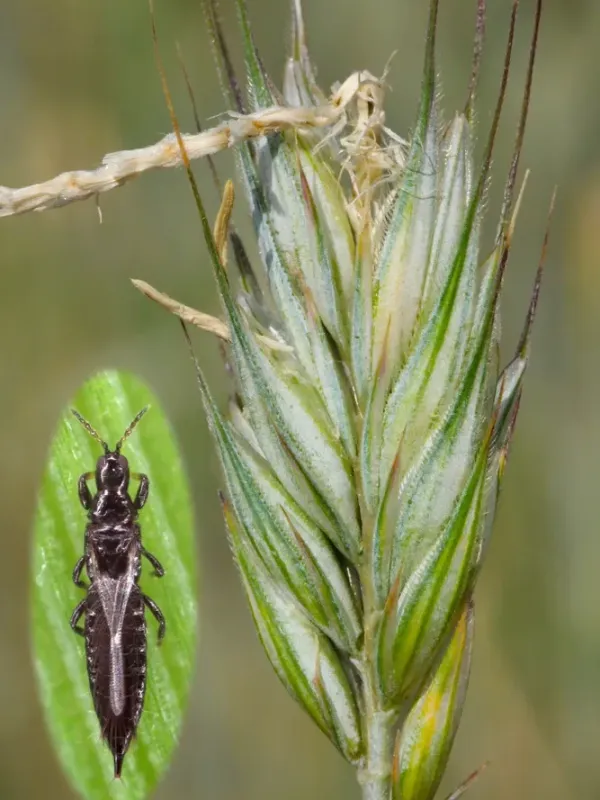
Wheat thrips (Haplothrips tritici) are small insects belonging to the order Thysanoptera. Adult individuals typically reach a length of about 2 mm and have a dark, elongated body.
The larvae of this pest are easily identified by their bright red coloration. They are highly resilient and capable of undergoing diapause in the soil during winter or periods of drought.
These insects possess a rasping-sucking mouthpart, which they use to feed on the sap of young plant tissues, specifically targeting the developing parts of cereal crops.
The life cycle involves several stages, including the egg, two larval instars, a prepupa, and a pupa, before reaching the adult stage. The larvae are the primary damaging stage.
Field monitoring is conducted by inspecting ears during the heading and flowering stages, as adult thrips are most active when temperatures exceed 20°C and weather is dry.
What it damages
The primary hosts for wheat thrips are winter and spring wheat. The pest occasionally appears on other cereals like barley or rye, but these are secondary to wheat in terms of economic impact.
Although historical agricultural documents may list plants like rapeseed, cabbage, or potatoes, these are not host plants where Haplothrips tritici completes its life cycle.
Damage is caused when adults and larvae feed on the glumes and florets of the ear. This feeding activity deprives the plant of nutrients during the crucial grain-filling period.
The resulting damage includes shriveled grain, reduced grain weight, and an overall decrease in yield quality, often leading to poor baking quality of the flour.
Severe infestations can lead to a condition known as "white ear," where the upper parts of the spike fail to fill, resulting in significant yield losses in affected fields.
When it appears
The development of wheat thrips is synchronized with the phenology of wheat. Larvae move from the soil to the surface when soil temperatures rise in the spring.
Adults typically migrate to the crops during the stem-elongation phase, reaching peak populations exactly when the wheat is heading and flowering, which is the most vulnerable period.
Eggs are laid under the glumes of the ear. The rate of embryonic development is highly dependent on ambient temperature, usually taking about a week to ten days.
After the larvae finish feeding on the developing grains, they descend from the ears and migrate into the soil or crop stubble to enter winter diapause.
Under typical conditions, the pest completes one generation per year, making it essential for farmers to protect the crops specifically during the heading stage.
Signs of infestation
Visual identification of infestation involves spotting white or bleached patches on the ears, as affected glumes lose chlorophyll and dry out prematurely.
Infested ears often appear deformed or partially empty, especially at the tip, due to the insect's interference with pollination and grain development.
The presence of large numbers of red larvae hidden within the florets is a definitive sign of infestation. They can be found by tapping the ear over a white sheet of paper.
Affected kernels are significantly lighter and smaller than healthy ones. In milling terms, such grain is often characterized by a lower test weight and higher screenings.
Heavy infestation levels often result in a significant drop in grain protein content, negatively affecting the economic value of the harvest for the producer.
Control measures
Cultural control practices, such as deep autumn plowing (moldboard plowing), are effective in burying larvae deep in the soil, preventing their emergence the following season.
Crop rotation and maintaining spatial isolation between winter wheat fields and spring cereal fields can help break the lifecycle and reduce migration rates.
Chemical intervention is necessary when the economic threshold is exceeded. This threshold is generally estimated at 10-15 larvae per ear during the milk-ripeness stage.
Systemic insecticides are generally preferred as they can reach the pests hidden inside the closed glumes of the wheat ear more effectively than purely contact-based products.
Timely application is critical; once the grain reaches the hard dough stage, the impact of the pest is already done, and chemical control becomes economically unjustified.
In brief
9
Damages crops
Content graph
Damages crops · 9
Content graph
Connections · Wheat thrips
Most often together:
Marketplace
Products · 30


Sharpei
ЗАТ Фірма Август, Росія.,селище Вурнари,
Insecticides
0
0
·
2.5K
1 offer
705.66 €per pack
Buy



Raut
Три Дельта Компані Інтернешнл, Гонконг, Китай.
Insecticides
0
0
·
753
2 offers
0.89 €per 1 l
Buy

Kordon
Три Дельта Компані Інтернешнл, Гонконг, Китай.
Insecticides
0
0
·
668
1 offer
0.89 €per 1 l
Buy


Insecticide preparation «ZETAVIT – agro», 10%, a.e., (zeta-cypermethrin
«Нанджин Ессенс Файн-Кемікал Ко. Лтд» (Китай)
Insecticides
0
0
·
142
No offers
—
Details


Biology
Taxonomy
- Latin name
- Haplothrips tritici
- Order
- Thrips
- Family
- Phlaeothripidae
- EPPO code
- HAPLTR
Community
Discussion
No discussions yet — be the first.