
Androthrips
Androthrips
Description
How to identify
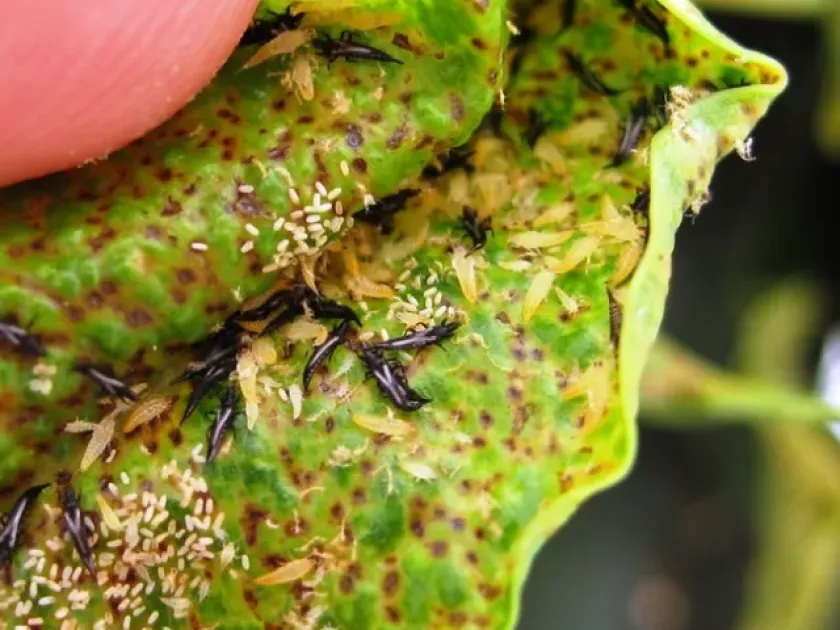
Androthrips is a genus of insects belonging to the order Thysanoptera and the family Phlaeothripidae. These insects are characterized by their slender, elongated bodies, typically measuring 1.5 to 3 mm in length.
Adults of this genus are generally dark-colored, ranging from dark brown to black, which helps them camouflage against the bark or foliage of host plants.
They possess fringed wings, a typical trait for the suborder Tubulifera, and a mouthpart structure designed specifically for piercing and sucking plant juices.
The larvae are smaller, softer-bodied, and usually paler than the adults. They tend to remain secluded within plant tissues or galls, making them difficult to spot without close inspection.
For accurate identification, experts often examine the specific morphology of the abdominal segments and the shape of the galls, which are unique to different species within the genus.
What it damages
Androthrips species are known to parasitize a wide range of plants, including tropical trees and various ornamental species, with a particular affinity for Ficus.
The damage is caused by both adults and larvae feeding on the succulent tissues of young leaves, terminal buds, and shoots, leading to stunted growth.
A distinctive feature of their impact is the induction of galls — abnormal tissue growth that provides the insects with a sheltered microhabitat for feeding and reproduction.
In addition to physical damage, the presence of these thrips can lead to chlorosis and premature leaf drop, which significantly weakens the overall vigor of the host plant.
Chronic infestations may disrupt photosynthesis and nutrient transport, ultimately leading to the degradation of the plant's aesthetic and structural integrity.
When it appears
The lifecycle of Androthrips is closely aligned with the growing season of the host plant. In greenhouse environments, they can complete multiple overlapping generations throughout the year.
The developmental stages include eggs, two larval instars, prepupa, pupa, and finally the adult stage. Development often occurs in protected areas on the plant.
High temperatures and consistent humidity accelerate their reproductive rate, making them particularly problematic during warm months or in year-round climate-controlled facilities.
In temperate climates, activity peaks during the spring and summer when young succulent growth is abundant and provides the necessary resources for the population to thrive.
During colder periods, the insects typically enter a state of dormancy, hiding in cracks in bark or within the remnants of galls, waiting for favorable conditions to return.
Signs of infestation
The earliest signs of an Androthrips infestation are small, pale spots or silvery streaks on the leaf surface, caused by the insects piercing the cells during feeding.
As the infestation progresses, the most prominent sign is the formation of leaf galls or tightly curled leaf margins where the insects reside.
Careful inspection of these deformed areas usually reveals the presence of small, dark, active insects and their fecal matter, appearing as tiny black specks.
Plants may also show general signs of stress, such as yellowing of the foliage, drooping of young shoots, and a noticeable reduction in the rate of new leaf production.
In severe cases, the affected foliage becomes brittle and may drop prematurely, leaving the branches bare and vulnerable to secondary infections.
Control measures
Effective management begins with regular monitoring, especially during the flush of new growth, to detect the first signs of gall formation or surface scarring.
Mechanical control involves the physical removal and destruction of affected leaves and shoots, which helps to significantly reduce the local population density.
Chemical control should prioritize systemic insecticides that can reach the insects inside the galls, as contact sprays are often ineffective against protected colonies.
Biological control agents, such as predatory mites (e.g., Amblyseius spp.) or specific entomopathogenic fungi, can be used to suppress populations in an environmentally friendly manner.
Maintaining proper plant hygiene and avoiding excessive nitrogen fertilization, which can produce an excess of succulent growth, are essential long-term preventive strategies.
Taxonomy
- Latin name
- Androthrips
- Order
- Thrips
- Family
- Phlaeothripidae
- EPPO code
- ANDTSP
Discussion
No discussions yet — be the first.