
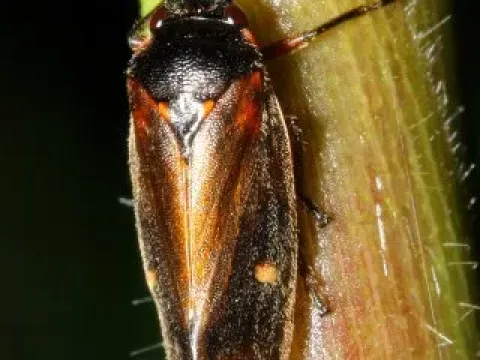
Common froghopper
Tomaspis basalis
The froghopper, taxonomically classified as Tomaspis basalis, belongs to the family Cercopidae within the order Hemiptera. These insects are known for their distinct morphology and remarkable jumping ability.
What the section contains
Common froghopper
Adult insects are typically identified by their robust bodies and specialized hind legs. They are skilled at navigating through dense vegetation, making them difficult to capture or observe directly.
The nymphal stage is famous for producing a protective foamy secretion, often called "cuckoo spit." This froth serves as a microhabitat that protects the immature insect from predators and desiccation.
The life cycle undergoes incomplete metamorphosis. Eggs are laid in protected areas, such as plant crevices or soil, and hatch into nymphs that progress through several instars before maturing into adults.
Understanding their taxonomy is essential for precise identification. Tomaspis basalis is distinct in its feeding habits and preference for specific host plants compared to other species in the family.
Tomaspis basalis primarily targets various grass species and cereal crops. They act as phloem and xylem feeders, inserting their stylets into plant tissues to extract nutrient-rich sap.
Feeding causes physiological stress to the host plant. The extraction of large volumes of sap leads to stunted growth, leaf chlorosis, and reduced vigor, directly impacting the final yield.
The injection of toxic saliva into the plant during feeding induces localized tissue death and necrotic lesions. This damage can severely compromise the plant's ability to perform photosynthesis efficiently.
Heavy infestations can lead to the wilting and collapse of young stems. In grain crops, this damage disrupts nutrient transport, often resulting in shriveled grains or poor head development.
Furthermore, these insects are known to act as vectors for various plant pathogens. By feeding on multiple plants, they facilitate the transmission of systemic diseases across agricultural fields.
The seasonal activity of the froghopper is heavily influenced by humidity and temperature. Nymphs typically emerge in late spring when environmental conditions become suitable for their development.
Adults are most active during the warmer summer months. They exhibit high mobility, enabling them to disperse across fields and colonize new, healthy plant populations as the season progresses.
Most populations exhibit one generation per year, though this can vary depending on regional climates. The winter is usually spent in the egg stage, hidden safely within organic matter or soil.
Increased moisture and moderate warmth provide optimal conditions for nymphal activity. Consequently, years with high rainfall in the spring often see an upsurge in the pest population.
By late summer, the life cycle slows down as host plants mature and become less suitable for feeding. Adult activity wanes as they prepare for the subsequent generation's overwintering phase.
The most reliable sign of an infestation is the presence of white, frothy masses on the stems or at the leaf axils. These "spittle nests" are easily spotted during the early morning hours.
Affected plants often display signs of yellowing or curling leaves. In severe cases, the foliage may exhibit signs of wilting even when water availability is adequate in the soil.
Upon closer inspection, the base of the stems may show fecal deposits associated with the foamy secretions. This creates a moist environment that may also support the growth of secondary fungi.
Sudden, frequent jumping of insects when a crop canopy is disturbed is a clear indicator of a significant adult population inhabiting the area.
Growth variability across a field, where some patches look significantly stunted or chlorotic compared to others, often marks the presence of localized froghopper colonies.
Management begins with good sanitation practices. Removing weed hosts from field margins significantly reduces the overwintering potential and primary infestation sites for the pest.
Cultural methods, such as deep plowing after harvest, help bury or destroy eggs deposited in plant debris. Proper crop rotation also serves as an effective disruption to the insect's life cycle.
When infestation levels surpass economic thresholds, chemical intervention using contact or systemic insecticides may be necessary. It is crucial to target nymphs before they produce their protective foam.
Biological control using natural predators or entomopathogenic fungi is increasingly encouraged as a sustainable practice. Encouraging natural enemy habitats around the farm can help keep populations in check.
Regular monitoring of crop fields during the late spring and early summer is vital. Early detection allows for localized treatments, thereby minimizing the overall chemical impact on the farm ecosystem.