
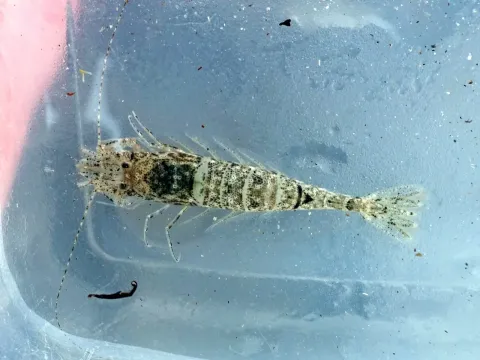
Common shrimp
Crangon vulgaris
The common shrimp Crangon vulgaris belongs to the order Decapoda, family Crangonidae. It is a marine benthic organism known for its grey-brown camouflage, which allows it to blend perfectly into sandy or muddy bottoms.
What the section contains
Common shrimp
Morphologically, the species has a flattened body and lacks a rostrum on its carapace, a distinct feature compared to other shrimp species. Adult individuals typically range from 30 to 90 millimeters in length, with females being notably larger than males.
These shrimp are primarily nocturnal, burying themselves in the substrate during daylight and becoming active at dusk. They have well-developed sensory organs that assist them in locating small organic matter and plant tissues, which form their dietary base.
The life cycle encompasses a pelagic larval stage that settles on the bottom after several molts. Growth rates and overall survival are heavily influenced by water temperature and salinity levels in their coastal habitats.
While ecologically vital, this species becomes a pest when populations bloom near aquaculture facilities or coastal hydroponic systems, threatening the stability of cultivated crops.
Crangon vulgaris causes significant damage to coastal hydroponic systems and nursery beds. The shrimp feed on delicate plant roots and young shoots, compromising the vascular integrity of the crops.
Mechanical damage to root systems leads to stunted plant development, chlorosis (yellowing of leaves), and frequently the total loss of seedlings within the first few weeks after planting in controlled systems.
In large-scale aquatic facilities, these shrimp can obstruct filtration and irrigation systems by accumulating organic debris and molted shells, which disrupts water flow and increases maintenance costs.
High shrimp densities in closed-loop systems often lead to localized dissolved oxygen depletion, further stressing the crops. The combined effect of physical feeding and environmental degradation can severely hamper yields.
The economic impact of this pest intensifies during seasonal migrations, as juvenile shrimp concentrate in river estuaries where agricultural and aquaculture plots are most densely located.
The peak activity period for Crangon vulgaris occurs during the warmer months, typically when water temperatures consistently exceed 10-12 degrees Celsius. In most temperate regions, this corresponds to the period between May and September.
Breeding cycles in the spring coincide with the peak growth phase of many aquatic crops. During this phase, larval stages are highly demanding of resources, leading to increased feeding aggression by the population.
By autumn, populations usually migrate to deeper, more thermally stable waters. However, unusually mild autumns may prolong the pest's presence near agricultural sites, extending the risk period.
Fluctuations in water salinity, often caused by heavy rainfall or flooding, can trigger sudden migrations, forcing shrimp into areas where they are not typically present but can cause significant damage.
Consistent monitoring of population density is recommended on a weekly basis throughout the growing season, specifically during early morning hours when these crustaceans are most visible.
One of the primary indicators of a Crangon vulgaris infestation is the presence of jagged or "gnawed" edges on roots and leaves. This specific type of damage is easily distinguished from fungal rot or insect herbivory.
The discovery of discarded carapaces (exuviae) within the substrate or at the bottom of irrigation channels confirms that a breeding population has established itself near the cultivation zone.
Increased water turbidity near the base of the plants is a tell-tale sign that shrimp are actively disturbing the substrate in search of food. This turbidity often blocks the light essential for the plant's photosynthetic processes.
Unexplained stunted growth in seedlings, even in the absence of obvious leaf damage, often indicates that the root neck is being grazed upon by these benthic crustaceans.
- Gnawed root and shoot tips
- Presence of molted carapaces
- Increased water cloudiness
- Clogged irrigation and filtration systems
- Unexplained nutrient deficiency symptoms
The most effective physical control method is the installation of fine-mesh screens on all water intakes to prevent shrimp from entering irrigation and hydroponic systems from open water sources.
Agrotechnical strategies include managing water parameters such as salinity levels. Crangon vulgaris is highly sensitive to rapid osmotic changes, which can be used to discourage their settlement in crop areas.
Night-time mechanical trapping is a highly recommended non-toxic approach. Traps placed in high-activity areas can significantly reduce population density without exposing the crops to harmful chemicals.
Regular maintenance of the facility floor, including the removal of sludge and organic waste, is essential, as these areas serve as natural hiding spots and primary food sources for the shrimp.
The application of biological repellents, which are safe for the crops and the ecosystem, can create a buffer zone that deters the shrimp while maintaining the integrity of the irrigation infrastructure.