
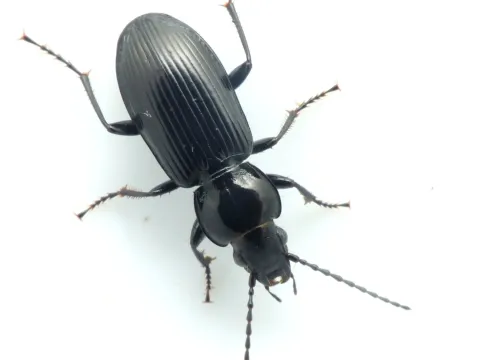
Common black ground beetle
Feronia nigrita
The common black ground beetle Feronia nigrita (synonym Pterostichus nigrita) belongs to the order Coleoptera and the family Carabidae.
What the section contains
Common black ground beetle
Adult insects reach sizes between 7 and 9 mm. The body of the beetle has a characteristic elongated oval shape, colored from coal-black to dark brown, with a noticeable metallic sheen.
The pronotum is slightly narrowed towards the base, and the elytra feature distinct longitudinal grooves filled with fine punctures.
The larvae are campodeiform, quite mobile, possessing well-developed thoracic legs and a strong chewing-type mouth apparatus.
This species prefers moist habitats, which is why it is often found in lowlands, field edges, and near irrigation ditches.
Both adults and larvae cause damage, as they feed on various agricultural crops throughout their development.
The beetle poses the greatest threat to winter and spring cereal crops, including wheat, rye, and barley.
Pests damage seeds in the soil and chew on young seedlings, resulting in thin stands and reduced plant density.
During mass outbreaks, these beetles can completely destroy crops in specific areas of the field, necessitating immediate replanting.
Besides cereals, the species may feed on sugar beet and corn seedlings, particularly during cold and damp spring seasons.
The common black ground beetle has a one-year development cycle, with adults typically overwintering in the topsoil layer or under plant debris.
Spring activity begins when soil temperatures rise to 8–10 degrees Celsius, followed by a period of supplementary feeding.
Egg-laying occurs in the soil during spring or early summer, and larvae hatch after 10–14 days, actively feeding throughout the summer months.
A second generation of young beetles emerges by late summer, which then enters overwintering to ensure the survival of the species during cold periods.
Peak damage occurs during the early spring when plants are in the germination phase and are most vulnerable to injury.
The first sign of the pest's presence is the appearance of bare patches in fields shortly after emergence.
Inspection of damaged areas reveals seeds with characteristic feeding marks, as well as gnawed or severed stem bases.
The presence of large beetle populations can be confirmed using pitfall traps (cups buried level with the ground) during the night.
Because the beetles are nocturnal, they can only be found during the day under soil clumps, plant residue, or in soil cracks.
Damaged seedlings often turn yellow, wilt, and die quickly, leading to a noticeable reduction in biological yield at early growth stages.
The primary agronomic control method is practicing crop rotation to prevent the continuous cultivation of cereal crops.
High-quality soil tillage, including deep autumn plowing, plays a crucial role in destroying the overwintering sites of the beetles and their larvae.
Seed treatment with insecticides prior to sowing is the most effective method for protecting seedlings from initial damage.
In cases of high pest density, spraying crops with authorized organophosphate or pyrethroid insecticides may be necessary.
- Deep autumn plowing;
- Timely weed control;
- Seed dressing with systemic insecticides;
- Optimizing cereal sowing dates.