
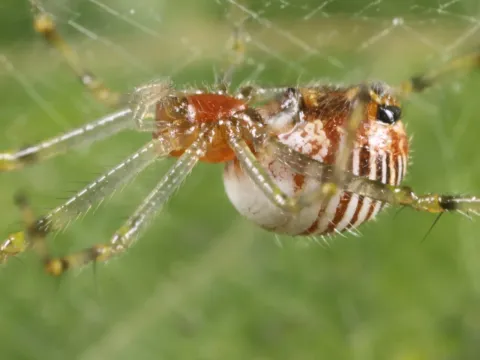
Comb-footed spiders
Theridion
The genus Theridion belongs to the family Theridiidae, commonly known as comb-footed spiders, distinguished by their ability to weave intricate, irregular webs.
What the section contains
Comb-footed spiders
Physically, these spiders exhibit a globular abdomen and slender legs, often showing cryptic coloration that ranges from pale yellow to complex brown patterns.
These spiders are primarily nocturnal or ambush hunters that spend most of their time stationed in their tangled webs, waiting for potential prey.
They are widely distributed in various ecosystems, including agricultural fields, gardens, and forests, where they prefer sheltered spots between plant structures.
Identification is largely based on the structure of their webs, which lack the geometric regularity found in orb-weavers, appearing as a chaotic mesh.
Theridion spiders do not feed on plant tissues and therefore do not cause direct damage like leaf-chewing or sap-sucking pests do.
The only impact on plants is aesthetic, as the accumulation of dust, debris, and insect remains on their webs can mar the appearance of ornamental plants.
In extreme cases, dense webbing might slightly shade plant parts, though this rarely affects the overall health or yield of a crop.
Because they act as predators of smaller insects, they often provide a natural biological control service within the garden ecosystem.
Categorizing them as pests is typically inaccurate; they are usually considered beneficial organisms that contribute to pest population management.
Activity in Theridion populations typically begins in the spring as temperatures rise, signaling the emergence of prey and the start of the breeding season.
Mid-summer represents the peak of their activity, coinciding with the highest insect abundance, allowing them to thrive and expand their web networks.
As autumn approaches, females prepare for reproduction, securing their eggs within robust, silk-spun cocoons hidden in safe locations.
Overwintering occurs in the adult or sub-adult stage, with spiders finding refuge in leaf litter, under tree bark, or in man-made structures.
The onset of the next season's activity depends on winter survival rates, which are influenced by local weather conditions and the availability of sheltered sites.
The most visible sign of a Theridion presence is the irregular, three-dimensional web suspended between leaves, stems, or branches.
During daylight hours, the spider is usually resting within the web or a nearby retreat, dropping to the ground if it senses vibrations or disturbance.
The presence of small, papery egg sacs attached to plant surfaces is a strong indicator of successful breeding and stable population occupancy.
Insect carcasses clinging to the web provide clear evidence of the spider’s predatory diet rather than any plant-feeding behavior.
An absence of leaf necrosis, stippling, or chlorosis helps distinguish these spiders from true plant-attacking pests.
Control measures against Theridion are generally unnecessary because they provide natural predation services that help regulate harmful pest populations.
If web accumulation is excessive for ornamental or commercial aesthetic requirements, physical removal using water jets or soft brushes is recommended.
Avoid broad-spectrum chemical insecticides, as these kill beneficial predators and often trigger subsequent outbreaks of aphids or spider mites.
Good horticultural practices, such as proper pruning and clearing of plant debris, are usually sufficient to manage their presence without intervention.
Maintaining a balanced garden environment ensures that these spiders continue to function as part of a healthy, self-regulating biological system.