
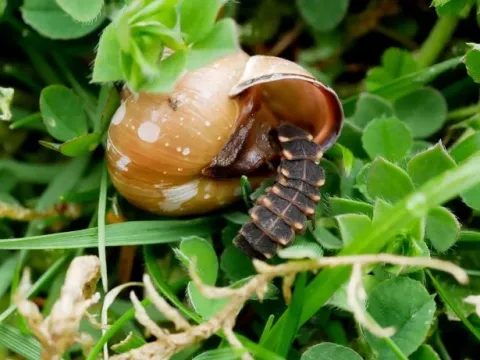
Common glow-worm
Lamprorhiza splendidula
The common glow-worm (Lamprorhiza splendidula) is a beetle belonging to the Lampyridae family. It is characterized by significant sexual dimorphism.
What the section contains
Common glow-worm
Males are winged, capable of flight, and possess typical beetle morphology. They are about 10–15 mm long and have brownish elytra.
Females are flightless and resemble larvae in appearance. They are worm-like and possess light-emitting organs on their abdomen to attract mates.
Larvae have a dark, flattened body with distinct yellowish spots along the sides. They are predatory and nocturnal, spending most of their time in soil or litter.
The life cycle involves complete metamorphosis, where the larvae grow through several stages, usually taking one to two years to reach maturity.
The common glow-worm is not a plant pest. It does not feed on any agricultural or ornamental plant tissues, leaves, or roots.
These insects are specialized predators that exclusively feed on mollusks, such as slugs and snails, which are common pests in gardens.
By consuming slugs, these beetles serve as natural biocontrol agents, effectively reducing the population of harmful mollusks in the garden environment.
There is no evidence of glow-worms causing damage to crops. On the contrary, their presence is a positive indicator of a healthy, non-toxic ecosystem.
Therefore, farmers and gardeners should not attempt to control them, as they are valuable allies in organic pest management.
Adults are most active during the summer, particularly in June and July, which is the mating season for the species.
During these warm nights, females emit a steady greenish glow to attract flying males, which is a classic sight in undisturbed gardens.
Larvae are active throughout the entire growing season, starting from early spring when the weather is warm enough for slug activity.
As winter approaches, the larvae seek shelter to hibernate, burying themselves in soil, leaf litter, or crevices in wood and stone.
Their life cycle is synchronized with the activity of their prey, ensuring that the predatory larvae are active whenever the slug population is high.
The most prominent sign of their presence is the characteristic greenish bioluminescence visible during the night in mid-summer.
Since they do not cause plant damage, you will not find chewed leaves or lesions that are typical of herbivorous pests.
If you find larvae, they are likely to be located in damp areas, near mulch, or under stones, exactly where slugs and snails congregate.
Their presence is a strong indicator that the garden is relatively free from harsh chemical pesticides and insecticides.
No special monitoring is required for this species, as they are part of the natural balance of a healthy garden ecosystem.
As beneficial predatory insects, glow-worms do not require any control measures. Eradicating them would be counterproductive to garden health.
The best approach is to protect their habitat by maintaining patches of undisturbed land, leaf litter, and avoiding chemical pesticide use.
Chemical control against slugs should be used with caution, as non-specific molluscicides can harm the glow-worm larvae as well.
Preserving natural biodiversity and avoiding heavy soil disturbance will encourage the population of these beetles to thrive.
- Avoid broadcast spraying of broad-spectrum insecticides.
- Maintain damp, undisturbed habitat areas.
- Leave areas of leaf litter for hibernation.