
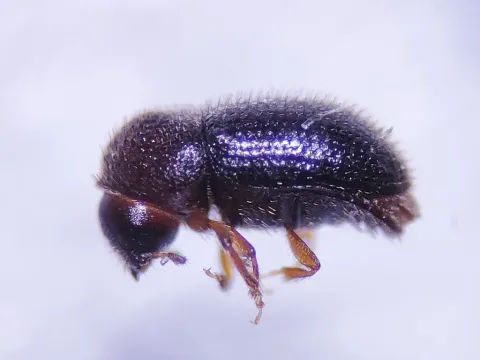
Stephanoderes punctatus
Stephanoderes punctatus
Stephanoderes punctatus belongs to the family Curculionidae, specifically the subfamily Scolytinae, commonly known as bark beetles. These beetles are characterized by their small, cylindrical bodies.
What the section contains
Stephanoderes punctatus
The name "punctatus" refers to the distinct punctures on the elytra (wing covers), which serves as a primary feature for taxonomic identification under a microscope.
Adults typically measure between 2 and 3 millimeters in length. Their dark brown to black coloration provides excellent camouflage against bark and plant stems.
The larvae are legless, white, and possess a prominent head capsule designed for boring into plant tissue. They are rarely seen as they complete their development inside the host plant.
As adults, they are equipped with functional wings, enabling them to migrate over considerable distances to infest new fields or storage facilities.
This beetle is a significant pest of agricultural crops, particularly affecting the stems of cereals and legumes. It acts as a primary borer, undermining plant structure.
Larval feeding activity creates intricate tunnels inside the stem, which disrupts the vascular system, leading to impaired nutrient transport and stunted growth.
In stored grain, Stephanoderes punctatus can cause severe economic losses by feeding on the endosperm and germ, effectively destroying the seeds' viability.
Woody plants can also be targeted, where the beetle attacks the bark and cambium, causing branches to wilt and potentially leading to the death of the tree.
High infestation levels often manifest in field crops as lodging, as the weakened stems are unable to support the weight of the plant under normal weather conditions.
The activity of Stephanoderes punctatus is highly dependent on temperature, with peak developmental rates occurring during the warm summer months.
During the spring, adults emerge from overwintering sites in crop residues or bark to locate suitable hosts for egg-laying.
In temperature-controlled storage facilities, the beetle can maintain a continuous generation cycle throughout the year, posing a constant risk to grain stocks.
Autumn marks a transition period where the population prepares for overwintering, typically in the larval or pupal stage protected within the plant material.
Environmental conditions with moderate humidity and high temperatures significantly accelerate the life cycle, leading to multiple generations per season.
The first indication of an infestation is often the presence of small, circular exit holes on the surface of stems or seed kernels.
The accumulation of "frass" (fine, sawdust-like powder) near the base of plants or inside storage bins is a clear indicator of active boring by the larvae.
Premature wilting or yellowing of the upper plant parts, despite adequate irrigation, is a frequent sign of internal stem damage caused by the beetles.
Internal examination of infested stalks reveals complex gallery systems where larval development occurs.
- Circular entrance/exit holes on plant tissue.
- Presence of fine sawdust-like frass.
- Unexpected lodging or wilting of crops.
- Presence of live beetles in grain samples.
Strict quarantine measures are essential to prevent the spread of Stephanoderes punctatus through the movement of infested agricultural products.
Cultural practices, such as the complete removal and destruction of crop residues after harvest, are vital to eliminate overwintering sites.
Fumigation of storage facilities is a highly effective control method to reach and eliminate beetles and larvae hidden deep within grain bulks.
The application of systemic insecticides during the peak flight of adults can significantly reduce the potential for egg-laying and future infestation.
Integrated Pest Management (IPM) strategies, including pheromone trapping for monitoring, are recommended to time chemical interventions accurately and minimize environmental impact.