
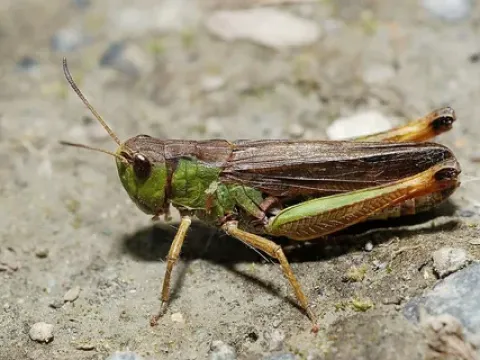
Beautiful grasshopper
Omocestus formosanus
The beautiful grasshopper (Omocestus formosanus) belongs to the family Acrididae (short-horned grasshoppers) within the order Orthoptera. This insect is of medium size and exhibits a cryptic coloration, typically green or brownish, which provides excellent camouflage in dense vegetation.
What the section contains
Beautiful grasshopper
Adults possess well-developed wings that extend beyond the hind knees, a key identification feature. The head is conical, and the pronotum features distinct side keels that curve slightly inward at the front, distinguishing it from related species.
Females are generally larger than males. They are equipped with a short ovipositor, which allows them to deposit egg pods into the soil or dense turf, ensuring the offspring remain protected through the winter months.
Nymphs go through several developmental stages (instars), gradually increasing in size. In early stages, they are lighter in color, helping them blend in with young seedling crops and surrounding soil.
The species prefers open landscapes, dry grasslands, and field margins. Because adults are highly mobile, they can easily migrate from wild meadows into cultivated fields to feed on available resources.
The beautiful grasshopper is a polyphagous pest, although it causes the most significant damage to cereal crops such as wheat, barley, oats, and millet. It can also thrive on wild grasses that serve as reservoirs for the population.
Both nymphs and adults cause damage. They utilize strong, chewing mouthparts to consume leaf blades, often leaving ragged edges or destroying the entire green tissue, which severely hampers the plant's photosynthetic capacity.
During outbreaks, populations can become dense enough to devastate young crops. In such cases, seedlings may be eaten down to the ground, leading to crop failure or significant delays in plant development.
The pest is especially dangerous during dry spells, when natural grass habitats dry out. In these conditions, grasshoppers migrate en masse to irrigated or lush agricultural fields in search of food.
Besides leaf damage, the insects may consume reproductive organs, including ears and panicles of cereals, directly reducing grain yield and negatively affecting the quality of the harvest.
The life cycle of the beautiful grasshopper is univoltine, meaning it completes one generation per year. The species overwinters in the egg stage, held within egg pods buried in the soil.
Nymph hatching occurs in late spring, triggered by the warming of the soil. This timing coincides with the rapid growth phase of perennial grasses and cereal seedlings.
The nymphal development takes approximately one month, during which the insects pass through five instars. This is the period when they are most vulnerable to environmental stressors and natural predators.
Adults typically emerge in mid-summer. During this time, they engage in active feeding, mating, and egg-laying, which continues until the arrival of the first autumnal frosts.
By late summer and early autumn, the population declines as adults die off after completing their reproductive cycle, leaving the next generation as eggs in the soil to wait for the following spring.
The first sign of infestation is the appearance of irregularly eaten leaf margins on cereal plants. Unlike some caterpillars, grasshoppers leave distinct, uneven edges on the leaves as they chew.
A second sign is the visual observation of insects jumping as you walk through the field. Even minor physical disturbance causes adults to leap, which is a clear indicator of their presence.
The presence of insect frass (droppings) on the leaves or the soil surface is another indicator. Small, granular pellets suggest that a significant number of insects have been feeding in the area.
Feeding hotspots are often concentrated along the edges of fields, especially those bordering unmanaged meadows, roadside ditches, or wasteland areas where populations often originate.
If the population is high, you may observe thinning crop stands or bare patches where the grasshoppers have completely stripped the foliage from the plants.
Effective agrotechnical practices include deep plowing after harvest. This action destroys the egg pods located in the upper soil layers, exposing them to predators or causing desiccation.
Managing weeds and regular mowing of field borders and roadside vegetation are essential to reduce the population at the nymphal stage before they have a chance to invade the main crop.
Chemical control should be implemented when the majority of nymphs are in their early instars, as they are most susceptible to insecticides at this time. Contact and systemic insecticides are typically used.
Biological control, including the encouragement of natural predators like insectivorous birds or the application of entomopathogenic fungi, can help keep grasshopper numbers below the economic injury level.
Regular field scouting using insect nets is critical to determine the density of the pest and to make informed decisions about whether insecticide application is necessary, thus protecting crop yield.