
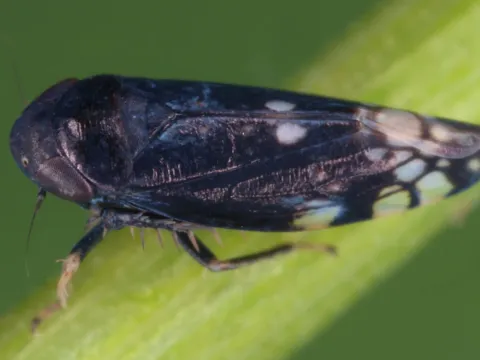
Beet leafhopper
Neoaliturus tem
The beet leafhopper (Neoaliturus fenestratus, commonly known as Neoaliturus tenellus) is a small, wedge-shaped insect belonging to the Cicadellidae family. Adult specimens typically measure between 3 and 4 mm in length.
What the section contains
Beet leafhopper
They exhibit a pale yellow to brownish coloration, often featuring distinctive spots on the head and thorax. Their wings are transparent and held roof-like over the body, allowing for powerful jumps when disturbed.
Nymphs resemble smaller, wingless versions of the adults and progress through several developmental stages. Their biological cycle is highly adapted to arid and semi-arid environments, favoring warm, dry conditions.
They possess keen vision and are highly responsive to environmental stimuli, facilitating their migration across agricultural landscapes. Their high mobility allows them to relocate quickly when host plants begin to dry out or mature.
Identification in the field is usually achieved by observing their sudden flight from foliage when a plant is touched or by using colored sticky traps for monitoring populations.
This pest affects a vast array of crops, including sugar beets, tomatoes, potatoes, and various cucurbits. They are also common on many weed species, which act as secondary reservoirs for the pathogens they carry.
The primary economic damage is not caused by sap-sucking itself, but by the transmission of viral and phytoplasma diseases, most notably the curly top virus. This disease can be devastating for infected crops.
Plants infected via the leafhopper's feeding exhibit stunted growth, leaf curling, and yellowing. In tomatoes, the fruit becomes deformed and drastically reduced in size, rendering the crop unmarketable.
In sugar beet production, this pest causes severe yield losses and reduces sugar content significantly. Once a plant is infected with the viruses transmitted by the insect, the process is usually irreversible.
The cumulative effect of these infections can result in entire fields suffering from reduced yields and lower quality, leading to substantial financial losses for commercial growers.
The beet leafhopper is most active during the warm months of spring and summer. Their population builds up rapidly when temperatures consistently exceed 20°C, favored by dry weather conditions.
Multiple generations can occur throughout a single growing season, depending on the local climate. This extended period of activity necessitates vigilant monitoring from the time crops emerge until harvest.
Autumn populations are particularly resilient and often overwinter in weed patches or crop residues. If spring conditions are favorable, these populations can migrate into early-planted fields, creating immediate challenges.
Rainfall and humidity play a regulatory role, as excessive moisture can hinder their development and survival. However, in hot, arid regions, these factors rarely limit population growth sufficiently.
Strategic timing of field surveys allows agronomists to predict infestation levels and implement protective measures before the insect reaches the threshold for mass damage.
Early symptoms of leafhopper presence and associated viral infection include marginal leaf chlorosis, followed by characteristic curling and brittleness. Leaves may develop a reddish or purplish tint.
A classic sign of viral transmission is the "bunchy" or "curly top" appearance, where the plant produces numerous small, deformed side shoots instead of normal healthy growth.
Detection is confirmed by shaking the foliage; the sudden, mass movement of insects is a clear indicator of infestation. Nymphs can also be found hiding on the undersides of leaves.
As the infection progresses, systemic damage causes the plant to wilt and collapse. Because the virus affects the vascular system, the decline often starts from the lower leaves and works its way upward.
In cases of heavy infestation, a sticky substance known as honeydew may coat the leaves. This often attracts secondary issues, such as sooty mold, further hindering the plant's photosynthetic capacity.
Integrated Pest Management (IPM) is the most effective approach. The primary strategy involves the destruction of host weeds in and around fields to remove the reservoir for the leafhoppers.
Systemic insecticides are frequently utilized when populations reach an economic threshold. Selecting products that provide long-lasting control is essential to prevent re-infestation during the susceptible stages of plant growth.
Cultural practices, such as choosing optimal planting dates and using resistant cultivars, can reduce the impact of the pest. Early-season protection is particularly critical for sensitive crops like tomatoes.
Yellow sticky traps provide a valuable tool for both monitoring population spikes and suppressing the number of adults in the immediate vicinity of sensitive plants.
Biological control methods, including the conservation of natural predators and parasitoids, are increasingly important in sustainable farming systems to keep populations below damaging levels.