
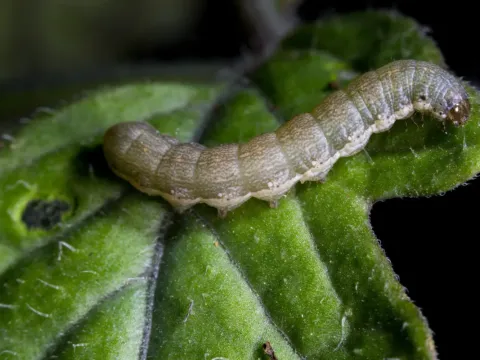
Beet armyworm
Laphygma
The beet armyworm (Spodoptera exigua) belongs to the Noctuidae family, order Lepidoptera. It is a small moth with a wingspan ranging from 25 to 30 mm.
What the section contains
Beet armyworm
The forewings are mottled grayish-brown with a distinct light spot in the center, while the hindwings are translucent white with a dark marginal line.
Eggs are typically deposited in clusters on the undersides of leaves and are covered with pale scales from the female's abdomen, giving them a fuzzy appearance.
Larvae vary in color from pale green to dark brown or black as they mature, usually featuring light longitudinal stripes along the body.
Pupae are shiny, reddish-brown, and usually reside in the soil at a depth of about 5 cm, where they undergo development before emerging as adults.
This species is a highly polyphagous pest, capable of attacking over 150 different plant species, making it a severe threat to global agriculture.
While known for damaging cotton, it is also a major pest for vegetable crops such as tomatoes, onions, peppers, cucumbers, and legumes.
Field crops including corn, soybeans, alfalfa, and sugar beets are frequently subjected to severe defoliation during heavy infestation periods.
Early instar larvae feed superficially, causing skeletonization of leaves, while older larvae consume the entire leaf tissue, leaving only the veins.
In addition to foliage, larvae often bore into fruits, buds, and young shoots, which directly impacts yield quality and marketability of the crop.
The pest overwinters primarily as a pupa in the soil, emerging as an adult once environmental temperatures become favorable, typically above 12-15°C.
Depending on the climate and temperature, this species can produce multiple generations per year, often leading to rapid population outbreaks in summer.
Hot and dry weather conditions, combined with irrigation, create an ideal environment for the rapid development and survival of offspring.
Peak activity generally occurs mid-to-late season when crops are in their most vigorous growth stages, increasing their attractiveness to egg-laying moths.
Generation turnover can occur every few weeks under optimal temperatures, necessitating continuous monitoring throughout the entire crop cycle.
The first signs of infestation are the presence of egg masses on leaf undersides, appearing as small, felt-like clusters of eggs.
Early damage is characterized by window-paning on leaves, where the larvae have eaten the lower epidermis but left the upper surface intact.
As larvae grow, they create large, irregular holes in the leaves, often accompanied by the presence of dark-colored frass on the plant surface.
Damaged fruits or reproductive parts may exhibit deep borings, leading to secondary rot and tissue degradation due to moisture and pathogens.
Massive presence of moths around light sources during the night often serves as a warning signal that a new generation of larvae will soon emerge.
Cultural control practices include deep plowing after harvest, which exposes pupae to harsh weather conditions and natural predators.
Weed management is essential, as many common weeds serve as alternative hosts during the early stages of the growing season.
Biological control agents, such as Bacillus thuringiensis or parasitic wasps, can be highly effective when applied against young larval stages.
Chemical control should be based on economic thresholds and involve the rotation of different insecticide classes to prevent the development of resistance.
- Deploy pheromone traps to monitor adult moth populations.
- Maintain regular field inspections to detect larvae early.
- Practice crop rotation to disrupt the pest's life cycle.