
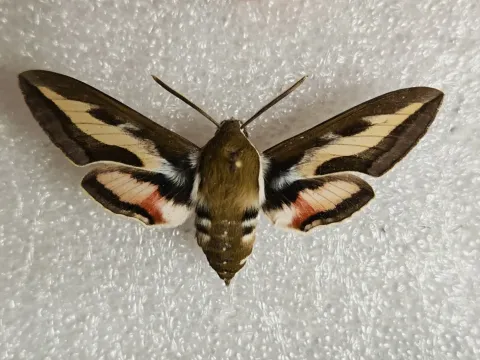
Bedstraw hawkmoth
Hyles gallii
The Bedstraw hawkmoth (Hyles gallii) is a prominent member of the Sphingidae family. The adult moth is characterized by a robust body, a wingspan of 60–80 mm, and distinct white stripes on its olive-brown forewings, enabling agile flight.
What the section contains
Bedstraw hawkmoth
The larvae, or caterpillars, are notable for their impressive size and striking appearance. They typically feature an olive or black body with rows of pale yellow spots, ending with a characteristic red horn at the posterior, which is a hallmark of this species.
The life cycle undergoes complete metamorphosis. In temperate climates, this species typically produces one generation per year, with pupation occurring in the soil or within thin cocoons composed of leaf litter and silk.
Adult moths are crepuscular or nocturnal, emerging in late spring and summer to feed on nectar. After mating, females lay eggs singly or in small groups on the host plants, which quickly hatch into ravenous larvae.
Their biological success is closely tied to thermal conditions; warm summers significantly accelerate the development of larvae and may occasionally lead to a partial second generation in warmer regions.
While the Bedstraw hawkmoth primarily feeds on Galium (bedstraw) species, it can occasionally cause significant defoliation to various ornamental and medicinal plants when high population densities occur.
The larvae are extremely voracious, consuming large amounts of foliage. This rapid defoliation reduces the photosynthetic capacity of the plant, leading to stunted growth, reduced vigor, and potential loss of yield.
By consuming leaf tissue down to the veins, the caterpillars create large, irregular bite marks that stress the plant, making it more susceptible to secondary pathogens, wilting, and environmental stressors.
In ornamental horticulture, the damage is particularly damaging to the aesthetic quality of plants. Even a small number of full-grown larvae can cause visible and unacceptable damage to private gardens and nursery stocks.
Host plants suffering from chronic larval feeding often exhibit signs of physiological distress, as the plant redirects energy from biomass production to tissue repair, ultimately impacting overall crop productivity.
The first sign of an infestation is the appearance of jagged holes along the leaf margins, which expand rapidly as the caterpillars progress through their later larval instars and consume more plant material.
Large, dark, cylindrical frass (fecal pellets) accumulating beneath the foliage is a classic indicator of larval presence. Their size usually corresponds to the growth stage of the caterpillars inhabiting the canopy.
Direct visual inspection of the underside of leaves and stems during the early morning hours is the most reliable way to spot the caterpillars, which often remain stationary while resting during the day.
General yellowing or thinning of the foliage on host plants indicates that the larval population is substantial and has likely been feeding on the plant for a significant duration, requiring immediate attention.
Discovery of subterranean pupae during autumn plowing or soil cultivation confirms that the species is established in the area and provides a crucial signal to prepare for potential spring management.
Hand-picking the caterpillars is a highly effective, non-chemical control measure, especially for smaller garden plots or early-stage infestations, given their large and easily identifiable size.
Implementing deep soil cultivation in the autumn disrupts the pupation sites of the moths, either physically destroying the pupae or exposing them to predators such as birds and ground beetles.
Biological control using Bacillus thuringiensis (Bt)-based formulations is an excellent strategy, as it targets young larvae specifically and minimizes harm to non-target pollinators and beneficial insects.
For large-scale agricultural operations, approved systemic or contact insecticides may be utilized if monitoring programs indicate that larval populations exceed established economic thresholds for the specific crop.
- Maintain field sanitation by removing host weeds from adjacent areas.
- Encourage biodiversity by providing habitats for natural predators and parasitoids.
- Monitor adult activity using light traps to predict and manage subsequent egg-laying.