
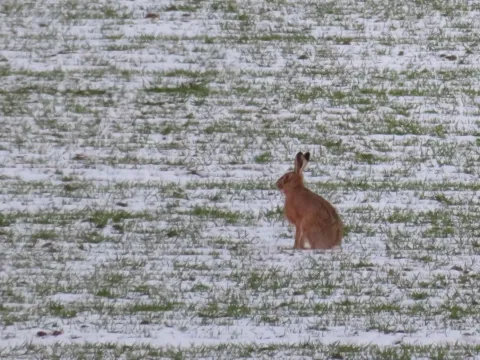
European hare
Lepus europaeus
The European hare (Lepus europaeus) belongs to the order Lagomorpha, family Leporidae. It is a large mammal characterized by long ears with black tips and powerful hind legs adapted for fast running.
What the section contains
European hare
Unlike the mountain hare, the European hare prefers open environments such as grasslands, agricultural fields, and forest edges. They are primarily nocturnal or crepuscular, making them elusive visitors in agricultural landscapes.
This species has a high reproductive rate, with females producing multiple litters annually during favorable conditions, which can lead to significant population surges in cultivated areas.
They are extremely cautious animals with acute hearing, allowing them to detect potential threats long before human intervention, which complicates standard pest control efforts.
Their biological adaptation to open fields enables them to survive across various seasonal conditions, often forcing them to rely on agricultural plantings during the harsh winter months.
The primary economic impact of the European hare is the damage caused to fruit trees during winter. Hares strip bark from the trunks and lower branches of young apple, pear, and cherry trees.
Ring-barking, where the hare removes the entire circumference of the bark, disrupts the tree's vascular system, causing the plant to wither and eventually die if left untreated.
In autumn and spring, hares pose a significant threat to winter cereal crops, as they graze on tender seedlings of wheat, rye, and oilseed rape, potentially reducing total yield density.
During the growing season, hares may damage vegetable crops by consuming leaves and succulent stems, particularly in gardens located near forests or wasteland corridors.
In forest nurseries and plantations, hares often bite off the tops of young saplings, leading to stunted growth, structural deformation, and loss of commercial value for the nursery stock.
Winter is the most critical period for orchards, as deep snow cover provides a platform for hares to reach higher branches, and the lack of ground vegetation leaves bark as their main food source.
Spring marks another peak in damage activity as young, green cereal sprouts emerge, providing a highly nutritious food source for the hare population coming out of winter.
Summer activity is generally more dispersed, as the availability of wild grasses and herbs reduces the immediate necessity for hares to feed on high-value orchard or field crops.
Autumn serves as a period for populations to stabilize and prepare for winter, during which time they may scout orchards and field edges to identify reliable food sources for the coming cold months.
Extreme weather conditions, such as prolonged freezing and heavy snow, force hares to concentrate their activities closer to human-managed areas, increasing the risk of significant damage.
The most distinctive sign of a hare infestation is the presence of parallel, vertical incisor marks on the wood, usually located on the lower part of tree trunks.
Droppings are frequently found in small piles near the base of damaged trees or along the paths commonly used by hares when entering a plantation.
Clear tracks and footprints on soft soil or snow around tree bases provide definitive proof of the animals' movement patterns within the cultivated area.
Stripped patches of bark, where the inner wood is exposed, are common indicators of recent feeding activity, often coupled with broken twigs on the ground.
In fields, patches of neatly clipped vegetation (as if cut with scissors) indicate herbivory by lagomorphs, distinguishing them from the jagged damage caused by insects or other rodents.
Physical protection is the most reliable method: wrapping tree trunks with fine-mesh wire, protective plastic tree guards, or heavy-duty horticultural fleece prevents bark damage.
- Installation of perimeter fences at least 1.5 meters high, ideally with the base buried slightly to prevent burrowing or pushing underneath.
- Application of chemical repellents on the bark, which use unpleasant scents or tastes to deter hares from feeding on the stems.
- Maintenance of clear field and orchard borders by removing weeds and tall grass to eliminate hiding spots for the animals.
- Use of acoustic or ultrasonic deterrent devices that create an uncomfortable environment for the sensitive hearing of the hares.
- Prompt application of horticultural wound dressings to any damaged bark to protect the tree from pathogens and fungal infections.
Integrating agricultural management with humane deterrents helps minimize losses while maintaining ecological balance within the surrounding environment.
Continuous monitoring of population levels near vulnerable crops allows farmers to react swiftly before extensive damage occurs during the peak winter months.