
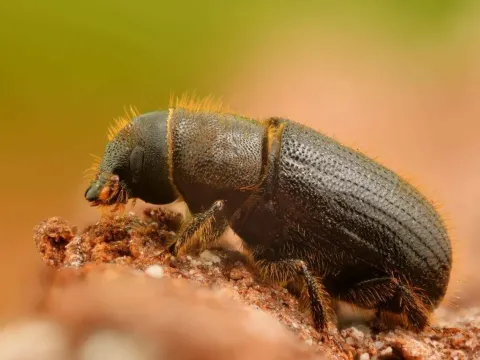
European spruce bark beetle
Ips interpunctatus
The European spruce bark beetle (scientific name Ips typographus) is a small wood-boring insect belonging to the Curculionidae family, subfamily Scolytinae.
What the section contains
European spruce bark beetle
Adult beetles are approximately 4 to 5.5 mm in length, with a cylindrical body, dark brown to black in color, and covered with sparse, long hairs.
The key morphological characteristic of this species is the declivity at the end of the elytra, which features four distinct teeth on each side, forming a depression.
Larvae are legless, white with a light brown head, and develop beneath the bark, feeding on the nutrient-rich phloem layer of host trees.
Adult beetles use pheromones to communicate and attract other individuals to a suitable host tree, facilitating mass colonization and overcoming the tree's natural defenses.
The primary host for Ips typographus is the Norway spruce, though it can also infest other coniferous species like pine and larch when populations are high.
The beetles target the cambium layer between the bark and the wood, effectively girdling the tree by destroying the transport tissues responsible for water and nutrient flow.
Initial colonization by male beetles creates a nuptial chamber, from which female beetles bore egg galleries that run parallel to the wood fibers.
Larval galleries extend perpendicularly from the maternal tunnels, creating a complex, star-like pattern underneath the bark that is typical for this species.
Once the vascular system is severed, the tree loses the ability to transport resources, leading to the rapid yellowing and browning of the needles, followed by death.
Adult beetles emerge from their overwintering sites in the soil or bark litter during the first warm days of spring, typically when temperatures exceed 15°C.
The flight period and mass colonization usually occur from late April to June, depending on local weather conditions and the tree's physiological state.
This species is multivoltine, meaning it can complete two or more generations within a single growing season if the summer is sufficiently warm and dry.
The second generation often peaks in mid-to-late summer, significantly increasing the pressure on forest stands and causing rapid damage during drought periods.
As temperatures drop in the autumn, the adults move to the base of trees or into the soil to enter diapause and survive the winter months.
One of the earliest signs of infestation is the presence of brown boring dust (frass) visible in bark crevices or at the base of the tree trunk.
Small, circular entrance holes about 2 mm in diameter appear on the bark as the beetles penetrate the wood surface.
Healthy spruce trees may exhibit resin flow (resin tubes) around the entry holes as they attempt to 'pitch out' or expel the invading beetles.
Crown symptoms are often delayed, beginning with a subtle loss of needle luster followed by a change in color from green to light yellow and finally reddish-brown.
Loosening bark is a sign of advanced infestation, indicating that the beetle galleries have occupied most of the circumference, effectively killing the tree.
Sanitation is the cornerstone of management; infested trees must be detected and removed from the forest before the next generation of beetles emerges.
Pheromone traps are essential tools for monitoring population density and are often used to reduce the number of attacking beetles in high-risk areas.
Maintaining a healthy, resilient forest stand through thinning and selecting appropriate planting sites helps reduce the risk of successful beetle outbreaks.
- Prompt removal and processing of infested timber.
- Strategic use of trap trees to attract and neutralize populations.
- Monitoring of storm-damaged trees that serve as initial breeding grounds.
- Encouraging natural predators such as woodpeckers and parasitic wasps.
Chemical control via trunk spraying may be feasible for high-value ornamental trees, but it is generally impractical and ineffective for widespread forest management.