
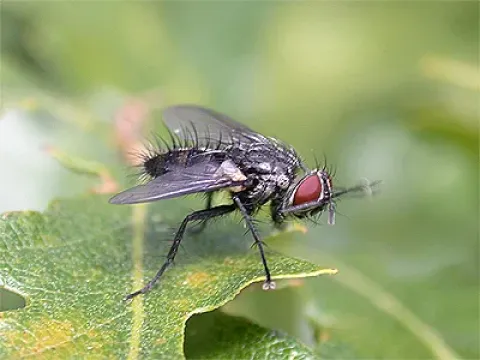
Exorista caryae
Exorista caryae
Exorista caryae is a member of the Tachinidae family, order Diptera. These flies are recognized by their robust bodies and prominent bristles, which are typical characteristics of tachinids.
What the section contains
Exorista caryae
The adults are medium-sized flies, often dark in color, adapted for quick flight when searching for a host.
The larvae are endoparasitoids, meaning they develop internally within their lepidopteran hosts, eventually killing them.
The life cycle undergoes complete metamorphosis, including egg, larval stages, puparium, and adult stages.
Identification often requires careful inspection of thoracic bristle patterns, which is best done by a specialist.
This species primarily targets various caterpillars that feed on trees, specifically within the Carya (hickory/pecan) genus.
As a specialized parasitoid, it plays a complex role in the ecosystem, serving as a natural regulator of caterpillar populations.
While not a direct pest of the fruit or foliage itself, its absence can lead to an increase in the number of primary leaf-feeding pests.
Damage to the plant is indirect, occurring only if the balance between pest populations and their natural enemies is disrupted by human activity.
Economic damage is generally non-existent unless agricultural practices eradicate the parasitoid population, leading to pest outbreaks.
The active season for Exorista caryae occurs during the spring and summer months, aligning with the larval stages of their hosts.
Their life cycle is highly synchronized with the availability of specific caterpillar hosts on host trees.
The overwintering stage typically occurs as a puparium, buried in the soil or protected in leaf litter near the base of the trees.
Adult activity peaks on warm, sunny days when they actively search for hosts to lay eggs on or near.
Multiple generations can occur per year depending on regional climate conditions and host availability.
The most reliable sign of their presence is the emergence of puparia from parasitized caterpillar carcasses.
There are no visible "feeding signs" or tissue damage caused directly by the fly, making it hard to track without active monitoring.
A sudden decline in leaf-eating caterpillar populations in a managed orchard often points to the activity of tachinid flies.
Adults can be observed foraging on nectar-bearing flowers in the orchard vicinity, contributing to pollination while searching for prey.
Verification of the species requires collecting larvae and rearing them to the adult stage in a laboratory setting.
Control measures are rarely necessary for Exorista caryae, as they act as beneficial biological control agents.
To preserve these parasitoids, it is essential to minimize the use of broad-spectrum insecticides that harm beneficial insects.
Integrated Pest Management (IPM) practices encourage the protection of natural enemies rather than total eradication.
Providing flower strips or cover crops can offer essential nectar sources for adult flies to ensure population sustainability.
- Minimize pesticide applications during peak fly activity.
- Implement selective pest management strategies.
- Maintain local biodiversity to support natural predator populations.