
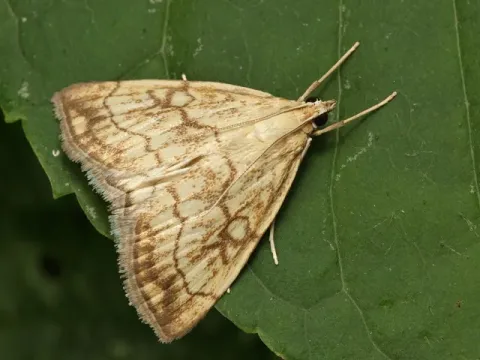
Evergestis straminalis
Evergestis straminalis
Evergestis straminalis is a moth species belonging to the Crambidae family. The adult moths are characterized by a wingspan of approximately 20 to 25 millimeters.
What the section contains
Evergestis straminalis
The forewings exhibit a straw-yellow or ocher coloration, which is the species' primary identifying feature. These wings are marked with subtle, darker transverse lines and spots.
The larvae, or caterpillars, reach about 20 millimeters in length. Their bodies are typically greenish, often featuring a darker longitudinal stripe along the dorsal side and small black tubercles.
Pupation occurs within a firm cocoon located in the surface layer of the soil. The pupae are reddish-brown and serve as the overwintering stage for the species in temperate climates.
These moths are primarily nocturnal, showing increased activity during warm summer nights. They are frequently found in moist habitats where suitable host plants are abundant.
The larvae are specialized feeders on plants within the Brassicaceae (cruciferous) family. Key agricultural hosts include various cabbage cultivars, radishes, turnips, and mustard.
Feeding damage is characterized by the consumption of foliage. Young larvae typically create small holes, while older larvae can cause extensive skeletonization of the leaves.
Beyond leaf consumption, the larvae frequently target the reproductive structures of the plant. Feeding on buds and flowers can lead to significant yield losses in seed-producing fields.
The wounds created by larval feeding act as entry points for bacterial and fungal pathogens, which can accelerate tissue decay and cause systemic plant infections.
In high-density infestations, the feeding activity can lead to complete defoliation of seedlings, resulting in substantial economic losses for commercial growers.
The flight period for the first generation typically commences in late spring or early summer, following the emergence of adults from overwintered pupae.
The biological cycle progresses through four distinct stages: egg, larva, pupa, and adult. Depending on local temperature conditions, the species may complete one or two generations per year.
Eggs are deposited in small clusters, primarily on the underside of host leaves. The incubation period is relatively short, often spanning about one week under favorable conditions.
Larval development generally lasts three to four weeks. Upon reaching maturity, the larvae descend to the soil to construct their cocoons for pupation.
Environmental factors, specifically humidity and temperature, play a crucial role in the survival rate of the population throughout the growing season.
The most prominent sign of infestation is the appearance of irregular holes and skeletonized areas on the leaves. Leaves may appear lace-like due to the destruction of soft tissues.
The presence of larval frass, appearing as small dark pellets, on the leaves or within the leaf axils, is a reliable indicator of recent or ongoing feeding activity.
Silk webbing is often used by larvae to pull leaves together, creating a sheltered environment. These small silk nests are easily visible during field inspections.
Damage to the buds and blossoms of cruciferous crops is a critical sign that requires immediate monitoring, as this directly affects the reproductive potential of the plant.
A sudden decline in plant vigor, coupled with the observation of curled or deformed leaves, often indicates a high population density of larvae within the crop.
Cultural control is a primary management strategy. Deep autumn plowing helps expose pupae to harsh winter conditions and avian predators, reducing the overwintering population.
Effective weed management is essential, particularly the removal of wild cruciferous weeds from field margins, which serve as alternate hosts and reservoirs for the pest.
Crop rotation protocols should be strictly followed. Alternating cruciferous crops with non-host species prevents the continuous buildup of the pest population in the soil.
Biological control options, such as the application of Bacillus thuringiensis, offer an effective and environmentally friendly method for targeting larvae without harming beneficial insects.
If economic thresholds are exceeded, targeted chemical applications using approved insecticides should be performed, ensuring compliance with pre-harvest interval regulations.