

Pest · Lepidoptera (butterflies) · affects Winter wheat, Field pea, Winter barley
Especially harmful
Brown-tail moth
Euproctis chrysorrhoea
Description
How to identify
The brown-tail moth (lat. Euproctis chrysorrhoea) is a destructive pest belonging to the Erebidae family. Adult moths have snowy-white wings with a span of up to 40 mm, and the tip of the female's abdomen is covered in a dense tuft of golden-brown hairs, which is the source of its name.
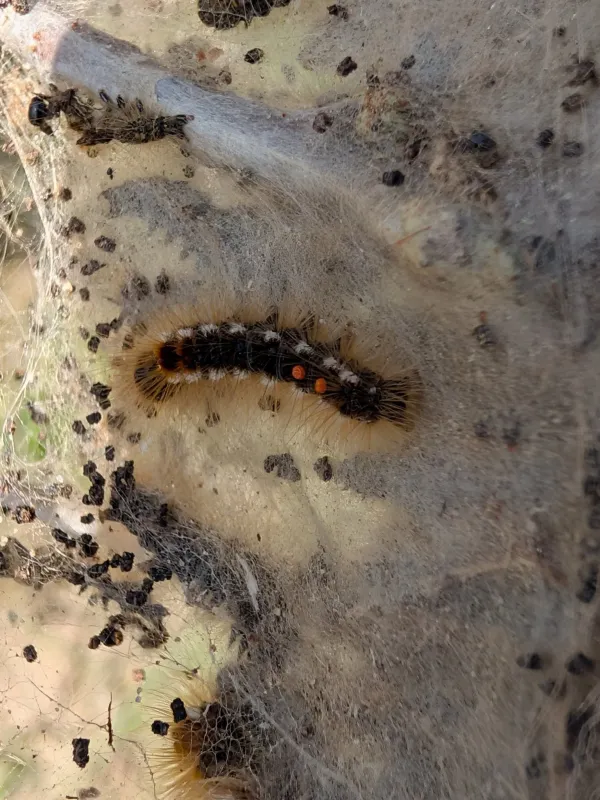
The caterpillars grow up to 30–40 mm in length and are covered in dense clusters of reddish-brown hairs. These hairs are extremely fragile and contain toxins that cause severe irritation, allergic reactions, and dermatitis upon contact with human skin.
The pupae are dark brown or nearly black in color, protected by dense silk cocoons. These cocoons are typically found within folded leaves tied together with strong silk webbing on the branches of damaged trees.
Egg batches are compact clusters of eggs covered with golden hairs from the female's abdomen. This protective "fur" layer effectively shields the eggs from desiccation and adverse weather conditions during the winter period.
Caterpillars overwinter in the second or third instar within special "winter nests." These are dense bundles of dried leaves securely attached to twigs with silk, making them clearly visible in tree crowns after leaf fall.
What it damages
This pest is a generalist feeder (polyphage) that attacks a wide variety of plants. Among agricultural and fruit crops, the brown-tail moth causes significant damage to apple trees, winter rapeseed, fodder beet, cabbage, peas, potatoes, and winter wheat.
The caterpillars cause the primary damage. In the spring, immediately after emerging from their nests, they feed on budding leaves and developing buds. During periods of massive outbreaks, they are capable of completely defoliating entire trees.
Damage to the foliage disrupts the process of photosynthesis, which drastically reduces the yield of fruit crops. For vegetable and grain crops, the pest destroys vegetative mass, leading to stunted growth and poor plant development.
Heavy defoliation weakens trees, making them more susceptible to secondary infections and winter frost damage. Prolonged defoliation can cause trees to fail to set fruit buds for the following season.
Massive outbreaks of the brown-tail moth can lead to a complete loss of crop marketability and, in severe cases, the death of young seedlings that cannot recover their green mass after the caterpillar invasion.
When it appears
The brown-tail moth has a univoltine life cycle (one generation per year). The adult flight occurs in mid-summer, typically in July, when they actively lay eggs on the underside of leaves of woody plants.
Caterpillars hatch in late summer or early autumn. Initially, they feed on the leaf epidermis, and after reaching the second or third instar, they construct nests for overwintering.
The spring emergence of caterpillars coincides with the onset of bud break on trees, which usually happens in April. During this time, they leave their nests and begin intensive feeding.
Pupation occurs in late May or early June. Caterpillars spin cocoons among the leaves or in branch forks, where they remain until they transform into adult moths.
The entire life cycle of the pest is strictly tied to temperature conditions. During warm and prolonged autumns and springs, the population density can increase significantly, requiring increased attention from agronomists for orchard monitoring.
Signs of infestation
The primary sign of the pest's presence is the existence of "winter nests." These are bundles of dry leaves firmly attached to branches with silk, which remain on the tree long after all other leaves have fallen.
In spring, a symptom is the premature "balding" of branches, where young leaves are eaten down to the veins as soon as they emerge from buds. Near these areas, one can often find characteristic shed skins from caterpillar molting.
The presence of caterpillars is easily detected by the silk webbing they spin around damaged shoot areas. As they grow, the caterpillars become more visible due to their bright and contrasting coloration.
Massive damage to vegetable crops located near shelterbelts or old orchards often indicates the migration of older caterpillars in search of additional food sources.
Finally, the presence of adult moths attracted to light sources in July serves as a signal to start preventive inspections of plantings to identify new egg batches on leaves.
Control measures
The most effective agrotechnical method remains the mechanical collection and destruction of winter nests. This should be done before bud break by simply pruning the infested branches and burning them.
In cases of high pest density, biological preparations based on Bacillus thuringiensis are used. These are effective against young caterpillars without harming beneficial entomofauna.
Chemical insecticides are applied during the phase of active caterpillar feeding. Preparations from the pyrethroid or organophosphate groups, as well as insect growth regulators, show high efficacy.
It is crucial to follow the timing of application: spraying is most effective during the period when caterpillars emerge from their nests, while they are still vulnerable and have not yet caused significant crop damage.
- Timely detection of infestation hotspots
- Use of pheromone traps for monitoring moth flight
- Encouraging natural enemies (parasitic flies and wasps)
- Maintaining spatial isolation between orchards and field crops
- Timely chemical control using systemic insecticides
In brief
7
Damages crops
Content graph
Damages crops · 7
Content graph
Connections · Brown-tail moth
Most often together:
Marketplace
Products · 2

Biology
Taxonomy
- Latin name
- Euproctis chrysorrhoea
- Order
- Lepidoptera (butterflies)
- Family
- Erebidae
- EPPO code
- EUPRCH
Community
Discussion
No discussions yet — be the first.