
Achaea catocaloides
Achaea catocaloides
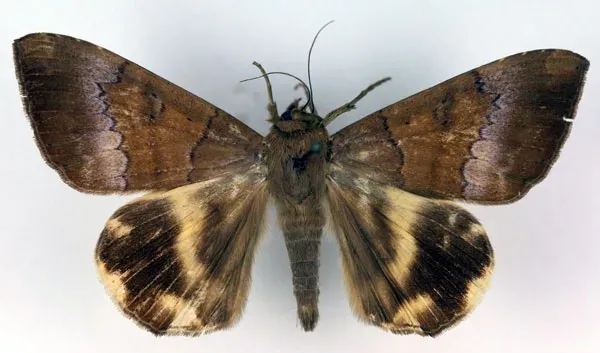
Description
How to identify
Achaea catocaloides belongs to the family Erebidae, suborder Noctuoidea. This moth is recognized as a significant pest of agricultural plantations in various regions of Tropical Africa.
The adult insect is a nocturnal moth with a wingspan of approximately 70–80 mm. The forewings feature a dark, mottled brown-gray pattern, which provides excellent camouflage against tree bark, while the hindwings often display distinct, contrasting spots.
The larvae (caterpillars) progress through several developmental instars, significantly increasing in size and changing in appearance. Younger caterpillars often maintain a secretive lifestyle, whereas mature larvae become extremely voracious.
Identification is often difficult due to the nocturnal behavior of the adults. Light traps are the most common tool used to monitor adult populations within agricultural plantations during the growing season.
The lifecycle of the insect is highly dependent on environmental conditions. Humid tropical climates promote rapid development, allowing for multiple generations per year, which significantly increases the risk to commercial crops.
What it damages
This pest is a polyphagous insect that causes substantial damage to plantations of cocoa, coffee, oil palm, and various fruit crops like mango. The larvae can devastate large areas of plantations in a very short amount of time.
The insect's diet encompasses a broad range of tree species. Beyond cultivated plants, larvae can feed on wild tropical vegetation, providing a natural reservoir that facilitates the spread of the pest to agricultural fields.
During population outbreaks, the larvae can completely defoliate a tree. Damage typically begins at the leaf margins, eventually consuming the entire leaf tissue and leaving only the central veins and midribs behind.
Beyond direct defoliation, mass infestation weakens the trees, leaving them susceptible to opportunistic phytopathogens and secondary pests, which often results in reduced yield for subsequent seasons.
Damage to young saplings is particularly critical and can result in the complete mortality of the plant, necessitating immediate intervention by agronomic teams to prevent total plantation loss.
Signs of infestation
The primary indicator of infestation is the sudden defoliation of tree branches. Since caterpillars frequently feed in groups or colonies, large-scale damage can appear within just a few days of initial settlement.
Large amounts of larval excrement (frass) visible on the ground under the tree canopy are a clear sign of active feeding in the upper branches. This serves as a reliable marker for initiating a canopy inspection.
Leaves exhibit characteristic ragged feeding patterns along the edges. Younger larvae may leave small perforations, while mature larvae consume the majority of the leaf, leaving only the petiole attached to the twig.
During the evening, nocturnal activity of the adults can be observed in the canopy. Using lights often reveals the presence of moths that quickly take flight when disturbed, performing rapid maneuvers.
Affected leaf tissues often turn yellow and necrotic, giving the tree an unhealthy, scorched appearance. Widespread infestation makes the canopy look as if it has suffered from severe environmental stress or mechanical damage.
Control measures
Effective management of Achaea catocaloides requires an integrated approach. Regular monitoring of plantations is essential, especially starting during the early stages of leaf development on host trees.
- Application of bio-insecticides based on entomopathogenic fungi or bacteria (e.g., Bacillus thuringiensis) to target early-instar larvae.
- Manual removal and destruction of caterpillar clusters when population density remains at lower, manageable levels.
- Use of contact-stomach chemical insecticides when pest populations exceed the economic threshold for intervention.
- Preservation of natural enemies, such as insectivorous birds and predatory insects, by maintaining biodiversity around the plantations.
Agrotechnical sanitation is a critical element of control. Removing weeds and non-commercial wild trees that serve as intermediate hosts helps to significantly suppress the pest population across the territory.
Taxonomy
- Latin name
- Achaea catocaloides
- Order
- Lepidoptera (butterflies)
- Family
- Erebidae
- EPPO code
- ACAECT
Discussion
No discussions yet — be the first.