
Leopard moth
Zeuzera pyrina
Description
How to identify
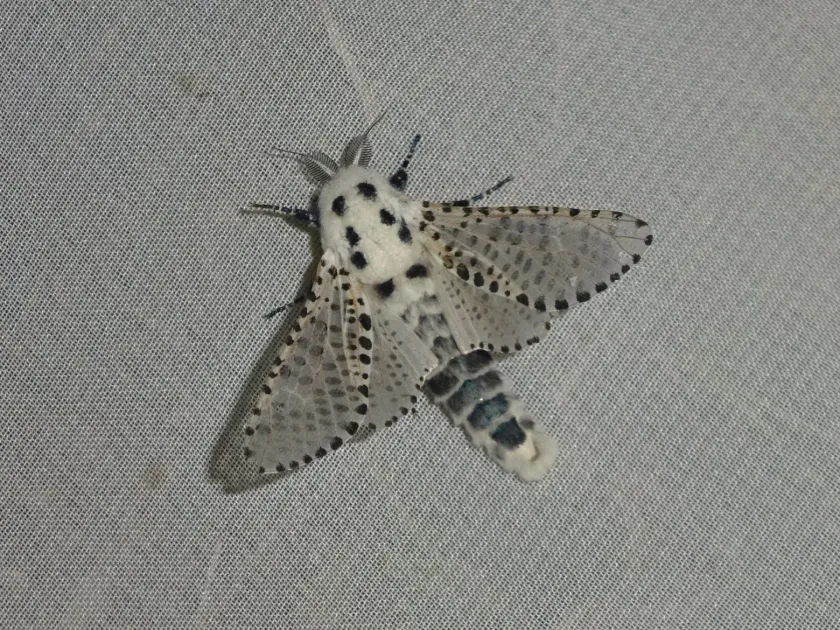
The leopard moth Zeuzera pyrina is a member of the Cossidae family within the order Lepidoptera. Adult moths have a distinct appearance with a wingspan of up to 70 mm, featuring white wings covered in numerous small bluish-black spots.
The larvae are yellow-white, reaching up to 60 mm in length, with shiny black dots and a dark head. Their appearance is distinct enough to be recognized by experienced gardeners when inspecting tree galleries.
The pupae are brown and cylindrical, equipped with small spines on the abdominal segments, which allow them to move through the tunnels inside the wood before the adult moth emerges.
The life cycle typically takes one to two years depending on the climate. The species is highly adaptable and thrives in various environments where suitable host trees are available for larval development.
Adults are nocturnal and are rarely seen during the day as they prefer to hide in the canopy or crevices of the bark, making them difficult to detect by visual inspection alone.
What it damages
This pest is a polyphagous insect, capable of infesting over 150 species of trees and shrubs. Preferred hosts include apple, pear, plum, cherry, quince, and various other fruit and ornamental trees.
Beyond orchards, the leopard moth frequently infests forest and ornamental species such as linden, maple, lilac, walnut, and horse chestnut, facilitating its rapid spread across landscape and garden areas.
Damage is caused by the larvae, which bore deep tunnels into branches and trunks. This activity interrupts the flow of sap, leading to the gradual wilting and drying of affected branches.
Young trees are particularly vulnerable and may die within a few seasons if heavily infested. Mature trees suffer from reduced vigor, lower fruit yields, and increased susceptibility to secondary infections.
The internal tunnels created by the larvae provide entry points for pathogenic fungi and bacteria, which often cause wood decay and structural weakness, leading to branch breakage during high winds.
When it appears
Adult moth activity begins in June and continues through the summer until early September. This is the primary period for monitoring populations using pheromone traps.
Females lay eggs in bark crevices or near buds. A single female can produce up to 1000 eggs, which hatch within 10 to 14 days, releasing larvae ready to begin their wood-boring life phase.
Young larvae start by feeding on tender shoots before migrating toward thicker branches and the main trunk, where they spend the majority of their developmental time tunneling through the wood.
Larvae hibernate inside the wood galleries during the winter. As temperatures rise in spring, they resume feeding and growth, eventually preparing for pupation inside the tree.
Pupation occurs within the tunnels. Before emerging, the pupa pushes itself toward the exit hole, leaving the empty pupal casing protruding from the bark after the moth has escaped.
Signs of infestation
One of the most obvious signs of infestation is the presence of small, granular excrement (frass) piling up at the base of the tree or on branch forks, pushed out of the tunnels by larvae.
Small, neat, circular holes can often be found on the bark. These are the entry/exit points where the larvae discard waste, sometimes covered with fine silk or wood shavings.
Sudden wilting or death of individual shoots during the growing season is a strong indicator that a leopard moth larva has girdled the branch or disrupted the vascular tissue.
Observation of broken or withered branches in the absence of obvious disease should trigger a careful inspection of the stem for the tell-tale boreholes and frass accumulation.
In stone fruit trees, excessive gumming (gummosis) can be a secondary reaction to the larval tunneling, indicating that the tree is trying to seal off the damaged tissues.
Control measures
Pruning and destroying infested branches is the most effective mechanical control method. Cuts should be made well below the entry hole to ensure the larva is removed from the tree.
For isolated infestations, professional arborists often inject systemic insecticides directly into the entry holes using a syringe, followed by sealing the opening with grafting wax or putty.
Preventive measures include the use of pheromone traps to monitor adult flights and time the application of insecticides to coincide with the period when larvae are newly hatched.
Chemical control is most effective when young larvae are still on the surface of the bark, before they have successfully penetrated deep into the hardwood where they are shielded from contact.
Maintaining high orchard hygiene, including proper fertilization and regular watering, helps the trees maintain their natural defenses against wood-boring pests and recover from minor damage.
Taxonomy
- Latin name
- Zeuzera pyrina
- Order
- Lepidoptera (butterflies)
- Family
- Cossidae
- EPPO code
- ZEUZPY
Discussion
No discussions yet — be the first.