
African fig fly
Zaprionus
Description
How to identify
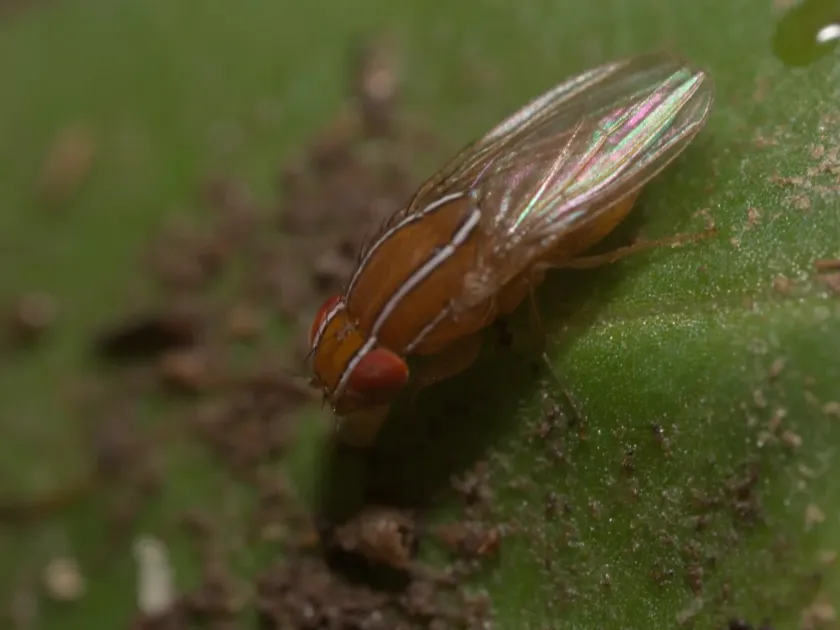
The African fig fly (Zaprionus indianus) is a small dipteran belonging to the family Drosophilidae. Typically, it measures between 2.5 and 3 mm in length and features a distinct yellowish-brown body coloration.
The most reliable identification characteristic is the pair of vivid white longitudinal stripes on the head and thorax, which are bordered by black lines. This unique pattern makes them easy to distinguish from other common fruit fly species.
The wings of this species are clear, without any spots, while the eyes are bright red. The body is covered with fine hairs, which are highly sensitive to the odors released by fermenting fruit.
The life cycle involves four stages: egg, three larval instars, pupa, and adult. Under ideal conditions, with temperatures exceeding 25°C, they can complete their life cycle in as little as 10 to 12 days.
Unlike many other drosophilids, the female possesses a sharp, robust ovipositor capable of piercing the tough skins of healthy, ripening fruits to lay her eggs.
What it damages
This pest is highly polyphagous, attacking over 70 different host plants. Crops such as figs, grapes, peaches, nectarines, and various berries are particularly susceptible to severe infestation.
The fly causes significant economic damage to commercial orchards, as it can compromise an entire crop during the ripening phase. The damage is often irreversible once the larvae have entered the fruit.
Beyond the direct destruction of fruit tissues, the infestation creates an entry point for secondary pathogens, including sour rot, fungal molds, and various bacterial infections.
In many regions, it is classified as a quarantine pest due to its rapid reproductive capacity and the difficulty of controlling its spread in dense orchard environments.
Tomatoes and other soft vegetables may also be damaged, especially if there are pre-existing minor cracks or wounds on the surface of the fruit.
When it appears
The population growth of the African fig fly is highly dependent on ambient temperature, with 20°C to 30°C being the optimal range for rapid development and reproduction.
Mass emergence typically occurs during the harvest season. Depending on the climatic zone, the fly can produce between 10 and 15 generations within a single growing season.
While cold temperatures below 10°C inhibit their activity, they can persist and continue breeding throughout the year in controlled environments like greenhouses or storage facilities.
The dispersal of the pest to new areas is often driven by the availability of ripe fruit, the scent of which acts as a powerful attractant for adult flies to migrate.
Late-season varieties are particularly vulnerable, as the accumulated population of the fly reaches its maximum density during their peak maturation period.
Signs of infestation
The primary symptom of infestation is the appearance of small puncture marks on the skin of the fruit, followed by localized softening and discoloration of the surrounding tissue.
Upon slicing the fruit, one can observe multiple small, white, headless larvae feeding inside the pulp. The internal tissue quickly becomes watery and emits a strong vinegar or fermented odor.
The fruit skin often exhibits patches of decay, which serve as ideal substrates for secondary fungi, leading to white or gray mold growth on the fruit exterior.
A noticeable sour smell around the trees is a strong indicator of an active infestation, as the fermenting juice attracts more individuals of the species.
Infested fruit typically drops from the tree prematurely and is unfit for market, processing, or long-term storage.
Control measures
Sanitation is the most critical management practice. Growers should remove and properly dispose of all fallen, damaged, or overripe fruits to disrupt the insect’s life cycle.
Monitoring using food-based attractant traps (such as apple cider vinegar or yeast solutions) is essential for early detection and tracking population spikes.
Physical exclusion using fine-mesh netting can effectively prevent females from accessing the fruit, which is a highly recommended strategy for organic or small-scale farming.
Chemical control should target the adult stage to prevent egg-laying, but due to the rapid generation cycle, applications must be frequent and rotated to avoid resistance issues.
- Prune orchard trees to improve airflow and reduce humidity levels.
- Utilize biological control agents like Beauveria bassiana-based formulations.
- Strictly adhere to phytosanitary regulations when transporting nursery stock or harvested produce.
Taxonomy
- Latin name
- Zaprionus
- Order
- Diptera (flies)
- Family
- Drosophilidae
- EPPO code
- ZAPRSP
Discussion
No discussions yet — be the first.