
Fennec Fox
Vulpes zerda
Description
How to identify
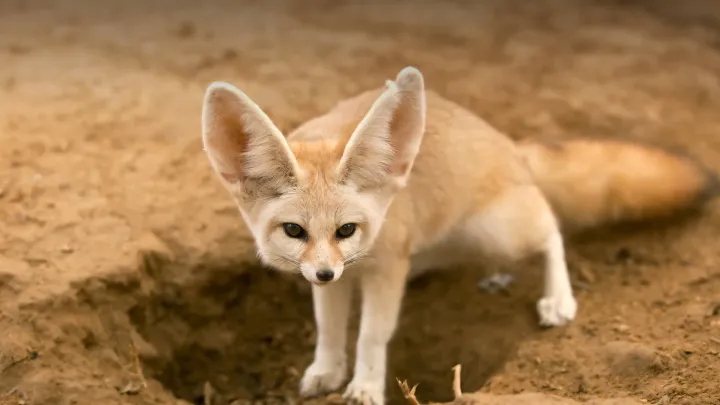
The Fennec Fox (Vulpes zerda) is a small, nocturnal fox species indigenous to the Sahara Desert in North Africa. It is easily identified by its exceptionally large, bat-like ears which serve as an efficient cooling mechanism.
This fox is remarkably small, weighing between 0.8 and 1.5 kilograms, and possesses a sandy-colored coat that provides excellent camouflage against desert sands.
The animal is primarily terrestrial and builds elaborate subterranean burrow systems, often in stable sand dunes or sandy soils which can occasionally overlap with agricultural boundaries.
Its paws are densely furred, an evolutionary adaptation that protects the animal from the extreme heat of the desert surface during its nighttime hunting activities.
Taxonomically, it belongs to the order Carnivora and family Canidae, exhibiting a highly specialized physiology tailored to survive in environments with scarce water resources.
What it damages
Generally, the Fennec Fox is not classified as a significant agricultural pest, as its natural diet consists mostly of insects, rodents, lizards, and eggs.
Occasional crop damage may occur when these animals dig burrows near cultivated fields, which can unintentionally disrupt the root systems of young shrubs and trees.
In oasis farming environments, they have been observed consuming fruits or vegetables if preferred food sources are scarce, though this is rarely a systematic behavior.
Their burrowing activity in loose sand can contribute to minor soil erosion, potentially affecting irrigation channels or small-scale farming infrastructure in desert fringes.
Overall, their presence is often considered beneficial due to their role in controlling populations of desert rodents and insects that could otherwise damage crops.
When it appears
Fennec Foxes are strictly nocturnal, and their activity cycles are heavily influenced by ambient temperature and the availability of food throughout the seasons.
Breeding usually occurs in the early months of the year, a period when the animals are most active and may be seen moving across wider territories in search of mates.
During the intense heat of the summer months, they become more inactive, spending the majority of their time in deep, cool burrows to maintain their body temperature.
Activity on the surface increases after minor rainfall events, which trigger insect reproduction, drawing the foxes closer to vegetation where prey can be easily found.
Farmers are most likely to encounter signs of these foxes during the harvest season when the presence of fruit or crops might temporarily attract them to fields.
Signs of infestation
The most prominent sign of a Fennec Fox is the entrance to a burrow, which appears as a clean, rounded hole leading to a tunnel system beneath the sandy soil.
Tracks left by the fox in soft sand are distinct, showing small paw prints with characteristic fur patterns from their insulating foot pads.
Droppings found in the vicinity of fields often contain remnants of insect chitin, beetle wings, or small seeds, reflecting their omnivorous, opportunistic diet.
Nocturnal vocalizations, which include high-pitched barks and chattering, are clear indicators that a population is active in the surrounding area.
Fresh mounds of sand displaced from burrow entrances are frequent indicators of recent subterranean construction or maintenance activities.
Control measures
In many jurisdictions, the Fennec Fox is considered a wild species of conservation concern, and lethal control measures are strongly discouraged or illegal.
The most effective method for crop protection is the use of robust fencing, buried at least 50 centimeters deep to prevent the foxes from digging underneath.
Non-lethal deterrents, such as motion-activated light systems or acoustic devices that emit high-frequency sounds, can successfully steer them away from farm property.
Maintaining strict field hygiene by clearing away harvest waste helps prevent foxes from viewing the plantation as a reliable source of food.
- Use of underground wire mesh barriers to prevent burrowing.
- Employment of non-harmful light sensors to discourage nocturnal entry.
- Habitat management to reduce the attractiveness of the field perimeter.
Taxonomy
- Latin name
- Vulpes zerda
- Family
- Canidae
- EPPO code
- CANIZE
Discussion
No discussions yet — be the first.