
Cruciferous flea beetle
Alopex
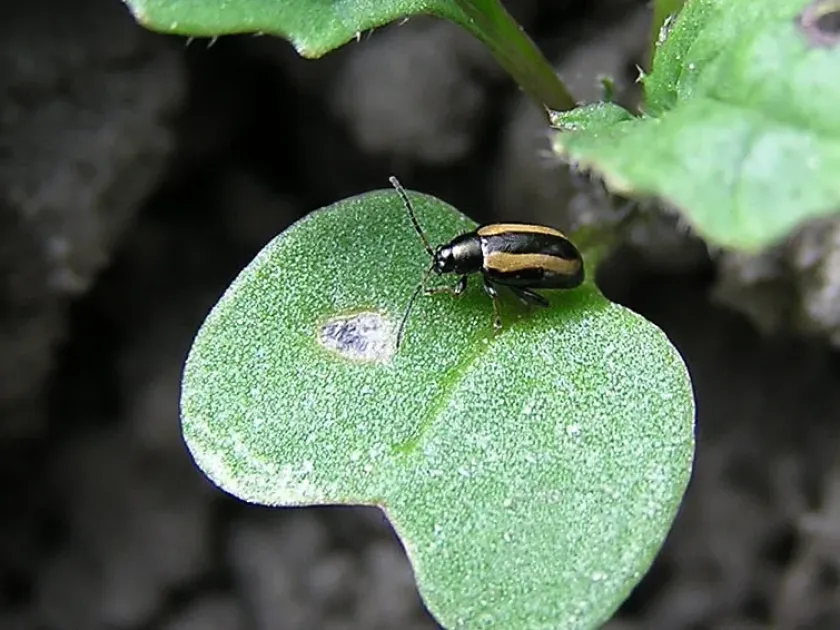
Description
How to identify
Cruciferous flea beetles (genus Phyllotreta) are small, jumping beetles belonging to the leaf beetle family (Chrysomelidae). They are notorious pests that specifically target plants in the Brassicaceae family.
The adults are tiny, measuring only 1.5 to 3 mm in length. They often possess a metallic sheen, while some species feature distinctive yellow stripes on their elytra. Their powerful hind legs are adapted for leaping, which is their primary escape mechanism.
These pests overwinter as adults in the soil or under plant debris. They emerge in the spring as temperatures rise, immediately seeking out young, succulent hosts for feeding.
The life cycle involves an egg stage, larval stage, pupal stage, and the adult stage. While adults feed on leaves, the larvae develop in the soil, feeding on roots and occasionally burrowing into the stems of young seedlings.
The development time is highly influenced by temperature and moisture. In hot, dry conditions, their population can explode within weeks, necessitating urgent monitoring and management measures.
What it damages
Cruciferous flea beetles cause the most damage to plants in the Cabbage family (Brassicaceae), including cabbage, radish, mustard, canola, kale, and broccoli. All these crops are highly susceptible, especially in their early growth stages.
Adult beetles feed on leaves, creating a characteristic "shot-hole" pattern. They graze on the upper surface, removing the epidermis, which leads to tissue dehydration and plant stress.
Larvae living in the root zone can cause significant stunting. By feeding on fine root hairs and main roots, they reduce the plant's ability to uptake water and nutrients, leading to poor growth.
Severe infestations on young seedlings can result in total crop failure. The destruction of the growing point, or apical bud, often prevents the seedling from developing further.
Beyond direct feeding damage, the wounds created by the beetles serve as entry points for various bacterial and fungal pathogens, potentially causing secondary infections that destroy the foliage entirely.
When it appears
Adults emerge from hibernation in early spring as soon as temperatures consistently stay above 12°C. This timing often aligns with the germination of spring-planted cabbage or canola crops.
The period of peak activity occurs during late spring and early summer. This corresponds with the seedling stage, when plants are most vulnerable to defoliation and root damage.
During the hot summer months, the beetles are most ravenous. If the season is dry, the lack of plant turgor pressure makes crops even more susceptible to the feeding pressure of the flea beetles.
As autumn approaches, the beetles begin feeding on remaining brassica weeds or volunteer crops, building up fat reserves to prepare for winter hibernation.
When the temperature drops, the adults migrate to sheltered locations such as field margins, hedgerows, or soil fissures to undergo dormancy during the winter months.
Signs of infestation
The most recognizable sign of an infestation is the presence of numerous tiny holes in the leaves. This makes the leaves look like they were peppered with buckshot, hence the nickname "shot-hole" damage.
When approaching an infected plant, the beetles will jump rapidly, making them highly visible. They tend to congregate in high numbers on sunny, warm leaves.
Seedlings may appear wilted or desiccated despite adequate soil moisture, which can indicate that larvae are damaging the roots below ground.
In cases of severe infestation, the plant may completely lose its photosynthetic capacity and stop growing, appearing brown and shriveled.
- Pitted, perforated leaf surfaces.
- Sudden mass jumping of beetles when disturbed.
- Dying off of seedling cotyledons.
- Loss of the central growing point.
- General stunting of seedling growth.
Control measures
Cultural control is the first line of defense. This includes sowing crops at the right time, practicing crop rotation, and removing all cruciferous weeds that provide a reservoir for the beetles.
Irrigation and overhead watering are highly effective against flea beetles. High humidity creates an environment they dislike and keeps the plant tissue robust, helping them outgrow the susceptible stage.
Using floating row covers or agricultural fleece during the first few weeks after emergence is an excellent mechanical barrier that prevents the adults from landing on the seedlings.
Chemical control involves the use of systemic insecticides or contact sprays containing pyrethroids or neonicotinoids if the economic threshold is exceeded. Always rotate chemistries to prevent resistance.
Biological control involves utilizing beneficial insects like predatory beetles and parasitic wasps, or applying microbial biopesticides that target the beetle life cycle in the soil.
Taxonomy
- Latin name
- Alopex
- Family
- Canidae
- EPPO code
- ALOXSP
Discussion
No discussions yet — be the first.