
Black-backed jackal
Canis mesomelas
Description
How to identify
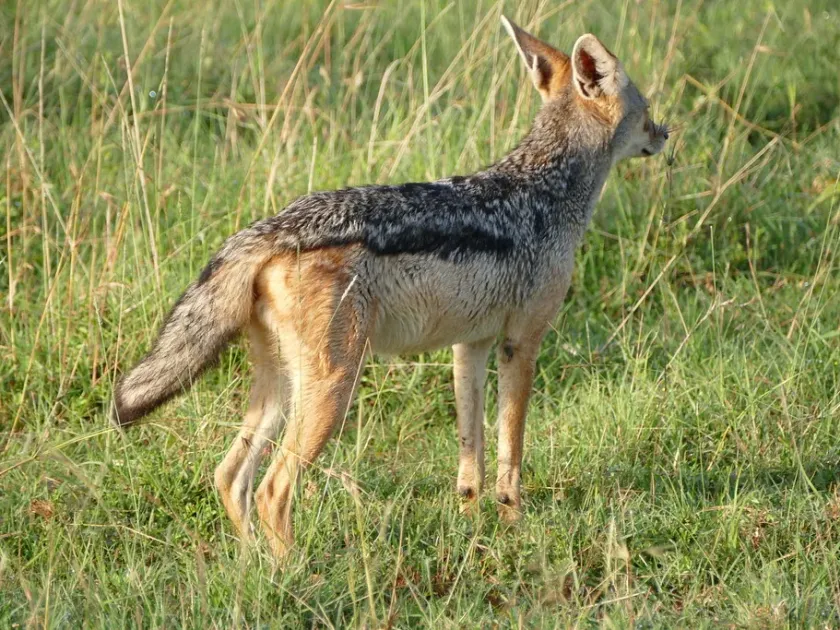
The black-backed jackal Canis mesomelas is a carnivorous mammal belonging to the family Canidae. It is characterized by a sleek body, pointed muzzle, and a distinctive black saddle pattern on its back that contrasts with its reddish fur.
These animals have a sturdy build, reaching body lengths of 60 to 90 centimeters and weighing between 7 and 13 kilograms, which makes them agile and fast across open landscapes.
Jackals are primarily nocturnal and crepuscular, meaning they are most active during dawn, dusk, and nighttime, which makes them difficult to spot during daylight hours in agricultural fields.
Taxonomically, the species is classified under the order Carnivora and the family Canidae. It is highly adaptable, inhabiting various ecosystems ranging from open savannas to agricultural regions near human settlements.
The population of black-backed jackals is known for its high reproductive rate, which can lead to rapid expansion within farming areas if not managed by effective wildlife control measures.
What it damages
The primary economic damage caused by black-backed jackals involves predation on livestock, particularly sheep, goats, and poultry, which leads to significant losses for farmers.
Beyond livestock, they are known to damage crops by consuming fruits such as grapes, melons, and watermelons. They actively tear into plantings in search of succulent produce and seeds.
In addition to eating produce, jackals cause mechanical damage to crops by trampling young seedlings and disturbing soil structures while moving through fields at night.
Furthermore, these jackals act as vectors for various zoonotic diseases, including rabies, which pose severe risks to livestock health and farm personnel safety.
The presence of jackals often leads to damage to agricultural infrastructure, including irrigation pipes and fences, which they may break or bypass while attempting to access food sources.
When it appears
Jackal activity peaks during harvest seasons when crops are ripening, as they frequently enter agricultural fields to feed on available fruits and vegetables during late summer and autumn.
During the spring season, when many farm animals give birth, jackals exhibit increased predatory behavior and are more likely to approach livestock enclosures to hunt young animals.
Climatic factors also influence their movement; during dry seasons, jackals tend to migrate toward irrigated fields where they can access both water and food sources.
Winter months often bring a scarcity of natural prey, compelling jackals to expand their range and frequently visit the outskirts of human-inhabited areas and farms in search of food.
The migratory cycles of jackals correlate with agricultural planting and harvest calendars, allowing farmers to predict the times of the year when predatory pressure is highest.
Signs of infestation
The presence of jackals is marked by oval-shaped tracks left in soft soil, which are typical for canids and usually show clear impressions of their claws.
A key indicator of damage is the presence of gnawed or partially eaten melons or fruits left directly in the field near the base of the plants.
Evidence of jackal presence often includes finding fur remnants, scat containing undigested plant fibers or seeds, and excavated dens near the edges of agricultural plots.
Auditory signs, such as their characteristic high-pitched yelps and howling, are frequent during the night and at dawn, signaling their activity in the vicinity.
Damage to perimeter fencing or the discovery of carcass remains with typical predator bite marks are clear indicators that jackals have gained access to livestock areas.
Control measures
Effective protection of crops requires the installation of robust perimeter fencing, preferably made of heavy-duty chain-link, which must be buried underground to prevent digging.
- Using high-voltage electric fencing (electric shepherds) to deter predators from entering fields and pastures.
- Implementing automated light and sound deterrents that simulate predator calls or produce strobe flashes.
- Deploying motion-activated trail cameras to monitor jackal activity and movement patterns.
- Maintaining clear field perimeters by removing dense brush and tall grass where jackals can hide.
Biological control methods include the use of trained livestock guardian dogs, which are highly effective at protecting pastures from wild canid intruders.
Proper sanitation and waste management on farms, particularly regarding livestock carcass disposal, is essential to avoid attracting predators with organic odors.
Taxonomy
- Latin name
- Canis mesomelas
- Family
- Canidae
- EPPO code
- CANIME
Discussion
No discussions yet — be the first.